Best viewpoints in Barcelona: the top 10 panoramas, ranked honestly
Barcelona is wedged between a mountain ridge and the sea, so almost every uphill street ends in a panorama. The hard part is choosing: some of the free ones can no longer be visited after dark, some paid lifts are worth every euro and others are not, and there is one specific window — from 45 minutes before sunset to 20 minutes after — when all of them look their best. Here are the ten that matter, with ticket, real effort, best light and a verdict.
ⓘ Note: this is not the official website This is not the official website of Mirador Torre Glòries, the Montjuïc Cable Car, Tibidabo Amusement Park or Barcelona City Council. We are an independent guide: the figures quoted come from their official websites, and bookings are processed by authorised partners such as GetYourGuide.Tickets and tours to book
22 options · Prices checked on 18 October 2026
No options match these filters.
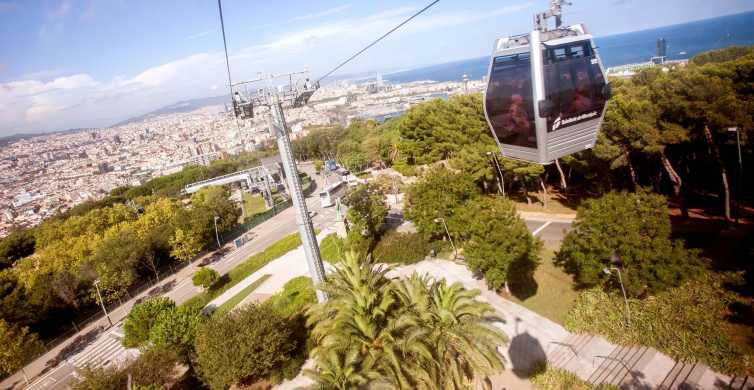
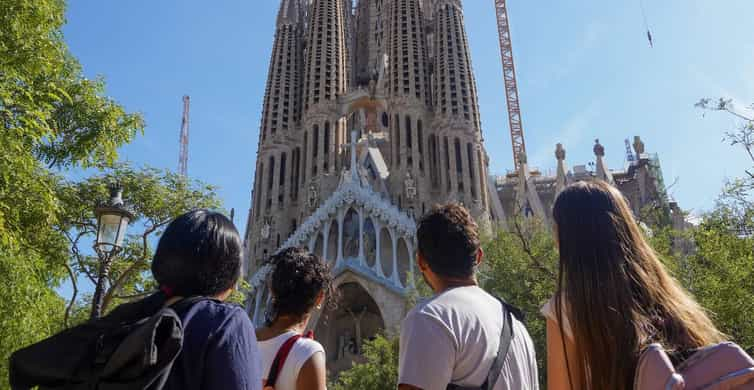

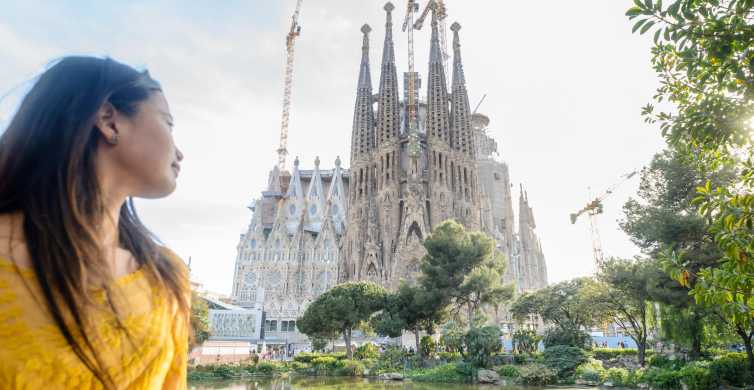
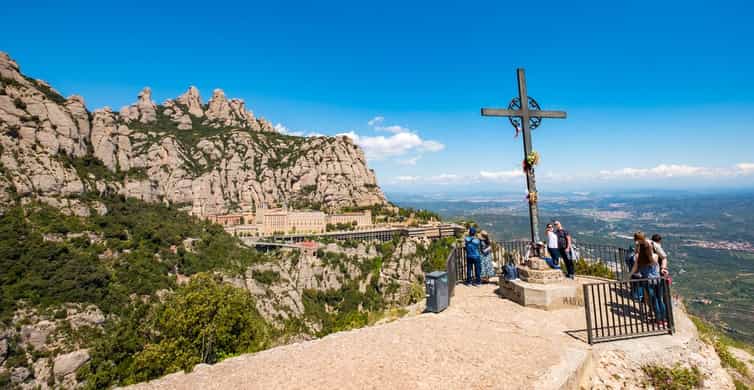
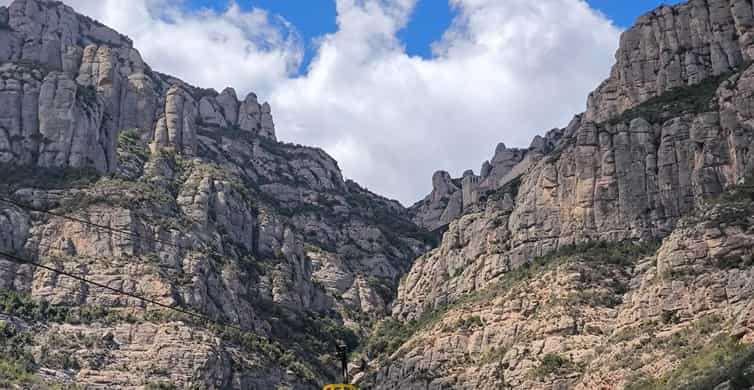
From Barcelona: Montserrat Monastery, Easy Hike, Cable Car
4.9 (1,335 reviews)
from €69.56Check dates

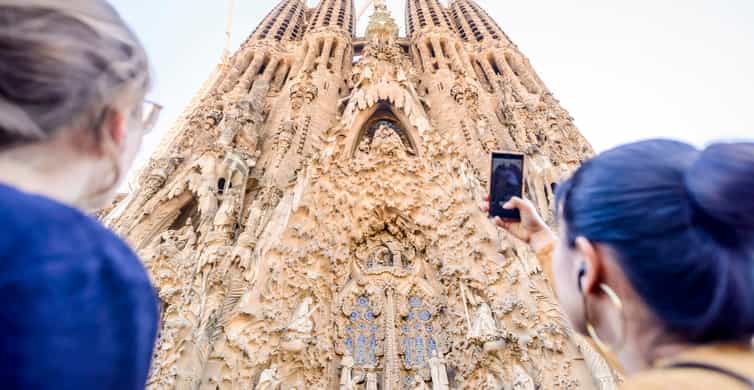
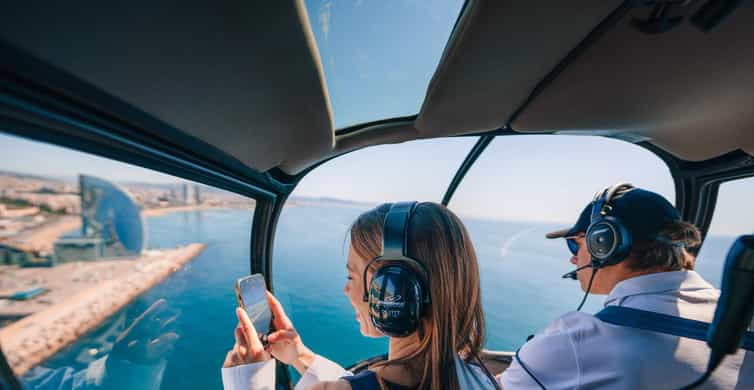
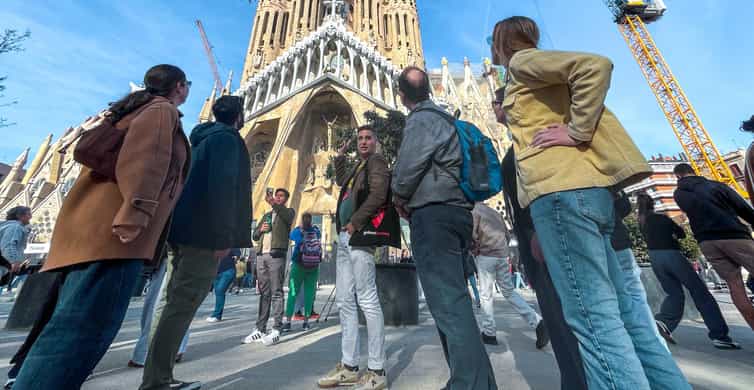
Barcelona: Helicopter, Boat Ride & Old Town Small-Group Tour
4.6 (1,365 reviews)
from €199.99Check dates
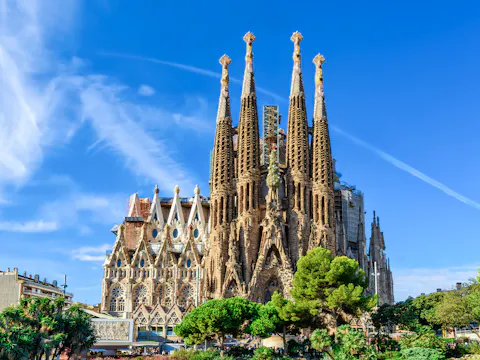
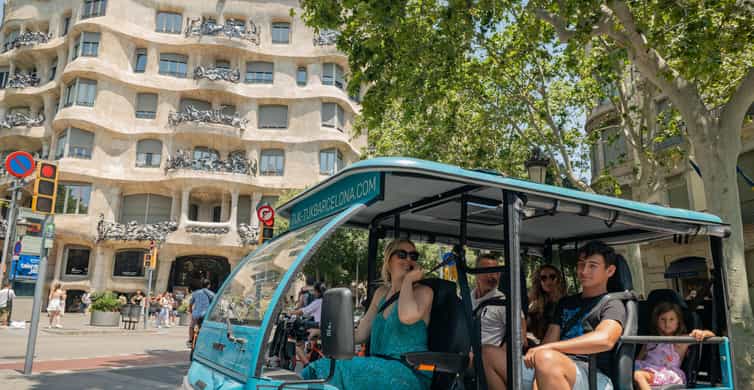
Barcelona: Private Panoramic Tuk-Tuk Tour of City Highlights
4.8 (688 reviews)
from €23.70Check dates



The essentials in 20 seconds
| Best free view | Turó de la Rovira (Bunkers del Carmel), 262 m and a full 360° · site open ~9:00-19:30 in summer, ~9:00-17:30 in winter |
|---|---|
| Best paid view | Mirador Torre Glòries: floor 30 at 125 m, general admission €18 online per miradortorreglories.com |
| Highest point | Tibidabo, 512 m, with the Sagrat Cor church · Cuca de Llum funicular €13.50 standalone (tibidabo.cat) |
| Zero effort | Montjuïc cable car: ~€16 return, eight-seat gondolas, no walking (telefericdemontjuic.cat) |
| The hour that matters | From 45 minutes before sunset to 30 after · sunset ~21:25 in June and ~17:25 in December |
| The real warning | Pickpocketing happens on the night walk down through Carmel, not at the top: put your phone away first |
The comparison table: free or paid, effort and best light
| Viewpoint | Ticket | Effort | Best light | Verdict |
|---|---|---|---|---|
| Turó de la Rovira (Bunkers) | Free | High: metro plus 15-20 min of hill and steps | Sunrise year-round; sunset only in winter | The best panorama in the city. You go for the view, not the comfort |
| Mirador Torre Glòries | €18 online (official) | None: metro, then a 34-second lift | Late afternoon into full darkness | The best indoor viewpoint: a genuine 360° and air conditioning |
| Montjuïc Castle | €12 general · €8 reduced · free Sun from 15:00 | Low by cable car; medium on foot | Mid-afternoon, with the sea lit up | The best harbour and sea view, with hard history thrown in |
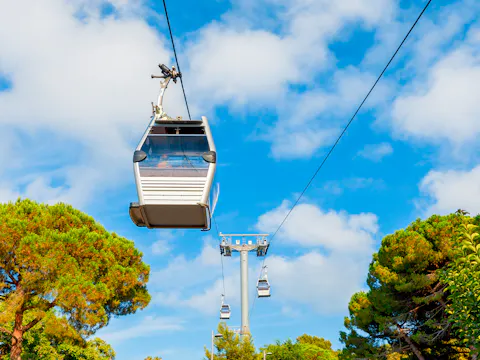
| Montjuïc cable car | ~€16 return | None | Any hour with a clear sky | A moving view; ride it up rather than down — going up you face the city |
| Tibidabo + Sagrat Cor | Church free · lift ~€5 · funicular €13.50 | Medium: FGC + bus 196 + funicular | A clear winter morning | The highest and the furthest. Come for the ensemble, not just the view |
| Park Güell (Tres Creus) | Free (open zone) | Medium: a steady climb | First thing in the morning | The view almost nobody looks for inside the most sought-after park |
| MNAC roof terraces | €2 building ticket · €12 general admission | Low: Montjuïc escalators | Afternoon, with the Eixample facing you | Two euros for a grand terrace: the best value on this list |
| Mirador de Colom | ~€10 | None, but a tiny lift | Mid-morning (it closes early) | Pleasant for the harbour, short for the price |
| Hotel rooftops | The price of a drink | None | Blue hour | You pay for the view in cocktails; book ahead in season |
| Helicopter flight | Check price when booking | None | Midday and afternoon, haze permitting | The splurge: a few minutes, but the only truly aerial perspective |
Prices and hours per miradortorreglories.com, telefericdemontjuic.cat, ajuntament.barcelona.cat/castelldemontjuic, tibidabo.cat and museunacional.cat, checked in August 2026. They change without notice — confirm before you go up.
One by one: how to get there, what you pay, when to go
1. Turó de la Rovira, the Bunkers del Carmel
This is the panorama that turned Barcelona into a poster: 262 metres up, bare concrete platforms, and the whole city laid out from the Collserola ridge to the sea with nothing in the way. Getting there: metro L5 to El Carmel or L4 to Alfons X, then 15-20 minutes of hill, steps and dirt path; buses 86, 87 and V17 get you closer. Ticket: free, no booking. Best hour: sunrise, no contest — raking light off the sea, the site open from 9:00 and virtually nobody there. Verdict: the best view in Barcelona is still free, but it asks something back — keep quiet and carry your rubbish down.
2. Mirador Torre Glòries
The city's newest viewpoint occupies floor 30 of Jean Nouvel's tower, 125 metres up; a glass-roofed lift gets there in 34 seconds and the view at the top is a genuine 360°, with the Sagrada Família in the foreground and the sea behind you. Getting there: metro L1 Glòries or L1/L2 Encants, right outside. Ticket: according to the official website (miradortorreglories.com), €18 online and €21 at the desk; €15 for ages 13-17 and over-65s; free under 12; €22 with Tomás Saraceno's Cloud Cities sculpture and €28 with the Skywine tasting, Thursday to Sunday. Best hour: the last slot of the day — this is the one enclosed viewpoint in the city where you can watch the sunset and then stay for the lit-up night. Verdict: pricey next to a free hill, but it is the most comfortable panorama, the cleanest, and the only one that still works in the rain.
3. Montjuïc Castle and the cable car
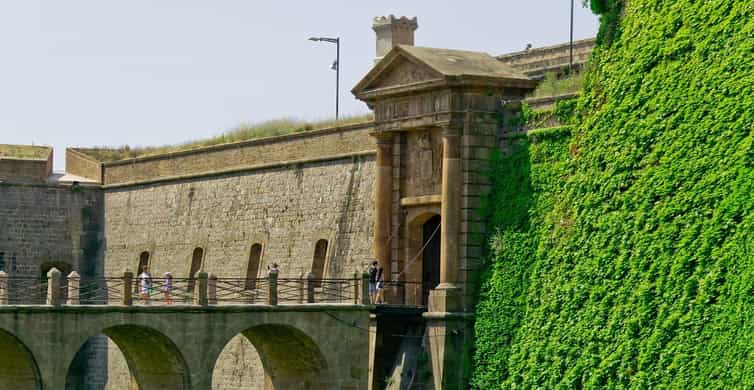
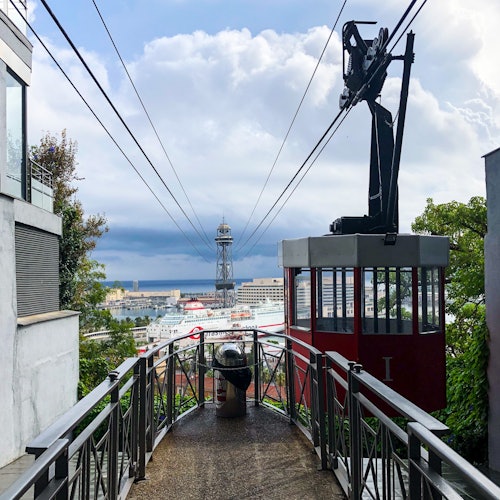
The 18th-century fortress crowns the hill above the port: the rampart walk goes all the way round, and from the south side you watch the container ships manoeuvre. Getting there: the scenic way is the Montjuïc cable car, eight-seat gondolas that leave from Parc de Montjuïc (at the top of the Paral·lel funicular) and climb to the castle; a return ticket is around €16 for adults and ~€11.60 for children aged 4-12 according to telefericdemontjuic.cat. Castle ticket: €12 general and €8 reduced according to ajuntament.barcelona.cat, free for under-16s, free every Sunday from 15:00 and all day on the first Sunday of the month. Best hour: mid-afternoon, when the low western sun lights the sea straight on. Verdict: the maritime view the Bunkers lack — and yes, ride up and walk down through the gardens.
4. Tibidabo and the Temple Expiatori del Sagrat Cor
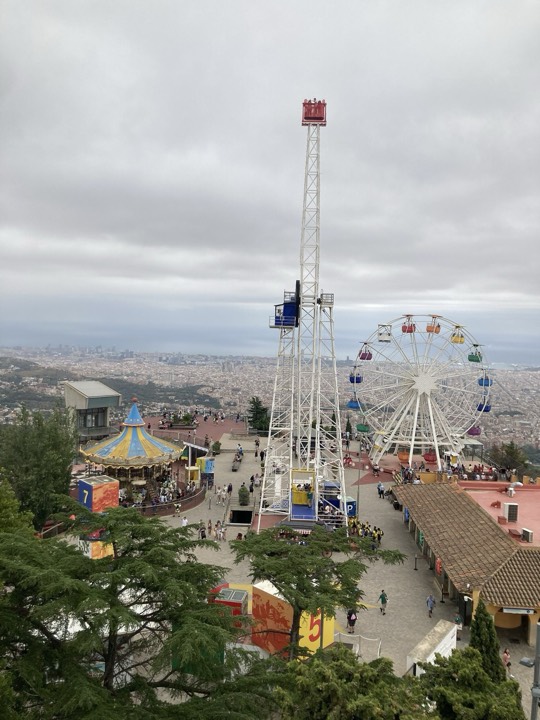
512 metres: the roof of the city. The neo-Gothic church visible from half of Barcelona is the work of Enric Sagnier and was built between 1902 and 1961; inside, a paid lift climbs to the upper terrace at the foot of the Sacred Heart statue. Getting there: FGC line L7 to Avinguda Tibidabo, bus 196 up to Plaça Doctor Andreu (the historic Tramvia Blau remains out of service), then the Cuca de Llum funicular, four minutes to the summit; a standalone funicular ticket costs €13.50, €6.75 for ages 4-12 and €3.95 for over-60s according to tibidabo.cat, and it is included in the amusement park ticket. Church: entry is free; the panoramic lift costs around €5, paid at the machine by the door. Best hour: a clear winter morning, when the north wind scrubs the air and you can pick out Montserrat. Verdict: the view is more distant than dramatic — the city shrinks — but the combination of church, funicular and century-old fairground earns the trip.
5. Park Güell: the free zone and Turó de les Tres Creus
The famous terrace with the wavy bench sits inside the paid Monumental Zone (€18), but the park's highest point, the Turó de les Tres Creus, is in the free-access area — and from up there you get the same sea, the same Sagrada Família, plus the park's own turrets in the frame. Getting there: metro L3 Lesseps or Vallcarca and a 10-15 minute climb; the outdoor escalators on Baixada de la Glòria save your legs. Ticket: free in that upper section. Best hour: first thing in the morning. Verdict: if you already have a ticket, climb up anyway; if you don't, it is the best way to get a taste of the park for nothing. Full opening hours and booking rules are in our Park Güell guide.
6. MNAC roof terraces
The Palau Nacional on Montjuïc opens its upper terraces, and from there you look straight down the axis of Plaça d'Espanya, past the Venetian towers, to the Eixample grid opening out towards Collserola. Getting there: metro L1/L3 Espanya, then the escalators. Ticket: per museunacional.cat, the building ticket costs €2 and includes the rooftop viewpoint; the €12 general museum ticket also covers it. Best hour: afternoon, with the city in front of you and the sun at your back. Verdict: two euros for one of the grandest terraces in Europe. The best value on this page.
7. Mirador de Colom (Columbus Monument)
The 1888 monument hides a lift up to a gallery about 60 metres above the point where La Rambla meets the harbour. Getting there: metro L3 Drassanes. Ticket: around €10. Best hour: mid-morning, because opening hours are morning-only and do not stretch to sunset. Verdict: the Port Vell view has its charm, but the lift is minuscule, the gallery is cramped and the visit is over in ten minutes. If you only pay for one viewpoint, don't make it this one.
8. Hotel rooftop bars
Barcelona has dozens of hotel terraces open to non-guests: in El Raval, in the Gothic Quarter, on the seafront. There is no admission charge — you pay for a drink, usually about what a viewpoint ticket costs — and in exchange you get a seat, shade and the whole blue hour without anyone moving you along. Getting there: any central metro stop. Best hour: half an hour before sunset. Verdict: the easiest option for a first evening. Book in summer, and check the dress code before turning up in flip-flops.
9. The Carmel and Horta hills
Around Turó de la Rovira sits a ring of neighbourhood viewpoints almost no visitor uses: Parc del Guinardó, with benches and pines; Parc de la Creueta del Coll; and Turó del Carmel, immediately above the bunkers. Getting there: metro L4 Alfons X or L5 El Carmel. Ticket: free. Best hour: any, because there is never a queue. Verdict: if the bunkers are packed — and they are — walk ten minutes further and you get the same city to yourself.
10. The splurge: a scenic helicopter flight
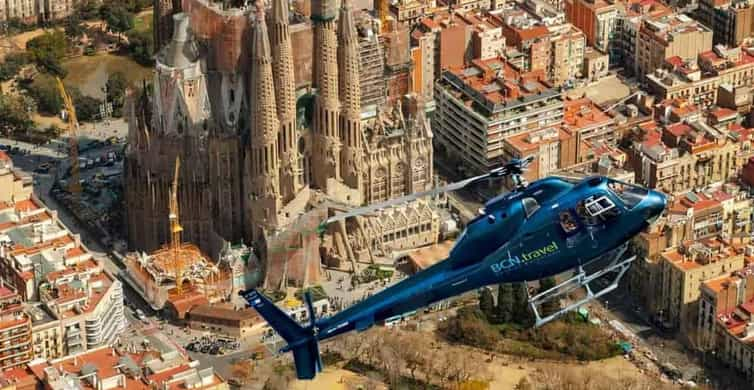
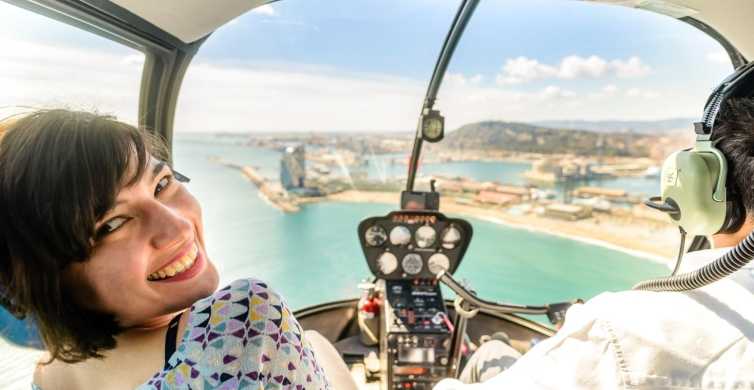
An official scenic helicopter flight takes off from the port heliport and runs along the coastline. It lasts a few minutes and costs far more than any ticket on this page, but it is the only way to see the Eixample grid as a drawing and the Sagrada Família from above. Best hour: a haze-free day; around midday the seabed shows up best. Verdict: expensive and brief. If budget is tight, save this for when the rest of the list is done.
The Bunkers, respectfully: hours, residents and how to behave
It helps to know why Barcelona's most famous viewpoint now has opening hours at all. For years Turó de la Rovira worked as a 24-hour open-air terrace: hundreds of people with speakers, bottles and litter every summer night, on top of a residential neighbourhood whose residents sleep fifty metres away. Since 2 May 2023 the battery site has been closed overnight, with a visiting window of roughly 9:00 to 19:30 in summer and 9:00 to 17:30 in winter.
The practical consequence is awkward but clear: in summer you will not see the sunset from the platforms, because the June sun goes down at about 21:25 and the site shuts nearly two hours earlier. In winter the timings do line up. The rest of the year there are two honest options: go up for sunrise — which is also when the light comes in off the sea rather than from behind you — or stay on the open hillside paths below.
Remember too that this is not just a lookout. These are the remains of a Republican anti-aircraft battery installed in 1937-1938 during the Spanish Civil War, with four 105 mm Vickers guns covering the city, and later the ground of Els Canons, a shanty settlement inhabited into the 1990s. It is now a MUHBA site — part of the city history museum — with interpretation panels beside the gun emplacements.
Sunset times by season, and photography advice
| Season | Approx. sunset | Be up there by… |
|---|---|---|
| Late June | ~21:25 | 20:30 |
| Mid-August | ~20:45 | 19:50 |
| Late September | ~19:45 | 18:50 |
| Late October (after the clocks change) | ~18:00 | 17:05 |
| December | ~17:25 | 16:30 |
| Late March (after the clocks change) | ~20:15 | 19:20 |
Indicative times for Barcelona's latitude; they shift by a few minutes each year and with the clock change (last Sunday of March and of October). Check the exact date before you head up.
Orientation — the bit nobody explains. Barcelona's coast faces southeast, not south: the sun does not set over the sea, it sets inland, behind the Collserola ridge and the Llobregat. That is why the northern viewpoints — Bunkers, Carmel, Park Güell — are at their best at sunrise, when the light rises off the water straight into them, while at sunset they offer something different but just as good: the entire city washed in frontal golden light while the sun drops to your right. From Montjuïc and the MNAC it works the other way round: in the afternoon the Eixample faces you and is beautifully lit.
- Blue hour is the good one. The 20-30 minutes after sunset, when the sky still holds colour and the city lights are already on, produce better photographs than the sun itself. Almost everyone leaves just before it starts.
- Bring something to brace against. Without a tripod, a wall or a rucksack is enough for a one-second exposure. At the Mirador Torre Glòries, press the lens against the glass to kill reflections and switch the flash off.
- Haze is a real factor. In summer, humid air erases the horizon by mid-afternoon; the sharpest days come after a storm or with a northerly wind in winter.
- For the full skyline — Sagrada Família, Torre Glòries, Montjuïc and sea in one frame — Turó de la Rovira is the only spot that lines them all up.
Safety, accessibility and what to combine each climb with
- Pickpocketing, mostly on the way down. The problem is not at the top but on the night descent through Carmel: dim streets, people staring at phones, groups strung out. Put your phone away before you start walking, wear your bag on your front and walk down with company. It is opportunistic theft rather than violence, but it is constant.
- Footwear. For the Bunkers and the Horta hills, closed shoes: the last stretch is loose earth and it slides on the way down. For everything else, anything goes.
- Accessibility. The Mirador Torre Glòries is fully accessible: lift from street level and an open, flat floor. The Montjuïc cable car and the castle work well too, with ramps and lifts at the stations. The MNAC has a lift to the terraces. Turó de la Rovira, by contrast, is not accessible — stairs and a steep dirt path — and at the Sagrat Cor the lift still leaves a few steps.
- Water and shade. There is no fountain, bar or tree at the top of the bunkers. In July and August, carry a litre and a half per person or go early.
- What to pair it with. Montjuïc fills a whole afternoon: cable car, castle, gardens and the MNAC terraces on the way back. The Mirador Torre Glòries slots in neatly after the Sagrada Família, two metro stops away. And if you plan to pay for several viewpoints, check first whether a city pass or card works out cheaper.
Why Barcelona has so many lookouts (one minute of context)
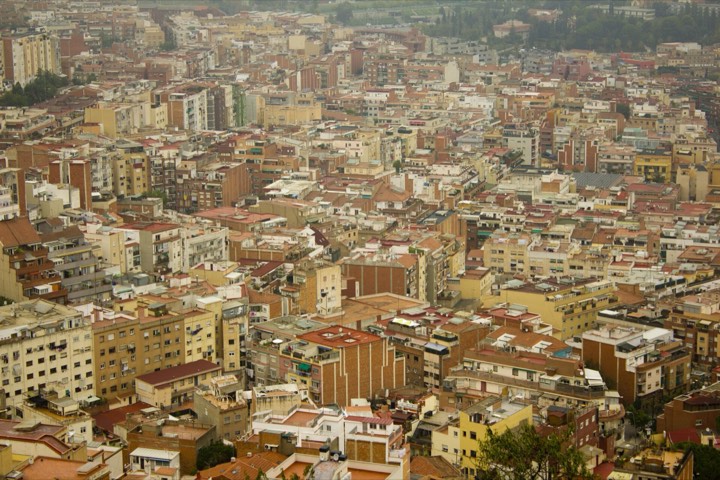
The city sits on a tilted plain between the Collserola ridge and the Mediterranean, closed off by two rivers. That relief explains almost everything: the Pla de Barcelona is one continuous ramp, so every hill on its inland rim — Rovira, Carmel, Putxet, Guinardó, Peira — looks out over the rooftops with nothing blocking it. And that is why, throughout its history, anyone who wanted to control Barcelona took its high ground first.
Montjuïc is the uncomfortable example: the castle you now visit for the views was built with its guns pointing at the city rather than out to sea, and it shelled Barcelona in 1842; it served as a prison and an execution site well into the 20th century. Turó de la Rovira repeats the pattern a century later, this time defending the city against the bombing raids of 1938. Tibidabo, by contrast, was claimed by faith and leisure at once: Enric Sagnier raised the Sagrat Cor church there while Dr Salvador Andreu opened the amusement park and the funicular in 1901, one of the oldest in Spain. Then in 2005 came the contemporary counterpoint — Jean Nouvel's Torre Agbar, renamed Torre Glòries in 2015, whose 30th-floor viewpoint opened to the public in May 2022. Five centuries of different motives — war, religion, business, tourism — all ending up looking at the same thing.
Frequently asked questions
What is the best viewpoint in Barcelona?
It depends on the hour. For a free 360° panorama with the whole city at your feet, Turó de la Rovira (the Bunkers del Carmel). For the best paid view with no walking, the Mirador Torre Glòries on the 30th floor, 125 m up. For sea and harbour, Montjuïc Castle reached by cable car. And for sheer altitude, Tibidabo at 512 m.
Can you watch the sunset from the Bunkers del Carmel?
In summer, not from the battery platforms: the fenced site closes around 19:30 and the sun sets at about 21:25 in late June. In winter the timings do line up, because sunset falls around 17:25 and closing is 17:30. The rest of the year, either go up at sunrise or stay on the open hillside paths — and keep the noise down and take your rubbish with you, because this is a residential neighbourhood.
How much does the Mirador Torre Glòries cost?
According to the official website (miradortorreglories.com), general admission is €18 online and €21 at the ticket office; €15 for ages 13-17 and for over-65s; free for under-12s. Adding the Cloud Cities sculpture takes it to €22 online, and the Skywine option with a wine tasting to €28, available Thursday to Sunday.
Are there free viewpoints in Barcelona?
Yes, and they are among the best. Turó de la Rovira, the Turó de les Tres Creus inside Park Güell's free zone, Parc del Guinardó, Creueta del Coll and the outer gardens of Montjuïc all cost nothing. Montjuïc Castle is free every Sunday from 15:00 and all day on the first Sunday of the month, according to ajuntament.barcelona.cat.
What time does the sun set in Barcelona?
The latest sunset of the year is around 21:25-21:30 in late June; by mid-August it is ~20:45, by late September ~19:45, and in December it falls around ~17:25. The good light starts about 45 minutes before, and blue hour runs for 20-30 minutes afterwards, so plan to be up there an hour before the official time.
Is it safe to visit Barcelona's viewpoints at night?
The risk is not the height, it is pickpocketing. The walk down from Turó de la Rovira and through Carmel runs along poorly lit streets with quiet stretches, and thieves work the mass exodus right after sunset. Walk down with company, put your phone away before you start walking, and avoid empty side staircases. The paid viewpoints are not an issue — they close earlier.
Which viewpoint is best for wheelchairs and pushchairs?
The Mirador Torre Glòries: a lift straight from street level to floor 30 and a flat deck. The Montjuïc cable car and the castle also work well, with ramps and lifts at the stations. The Bunkers del Carmel are not accessible — the last stretch is stairs and a sloping dirt path — and the Sagrat Cor lift still leaves some steps.
Is the Columbus Monument viewpoint worth it?
Only if you specifically want the harbour and the foot of La Rambla from about 60 m up. The ticket is around €10, the lift is tiny and the gallery is cramped, and it opens on morning hours only, so it is no use for sunset. The same money buys far more panorama at the Mirador Torre Glòries or on the cable car.
Book your climb before the sunset slot sells out
The last time slots at the Mirador Torre Glòries are the first to fill, especially Thursday to Sunday. Free cancellation on most options: lock in the date and decide later.
See times and prices