Colònia Güell crypt: tickets and how to get there
Ten euros, twenty minutes on a train, and almost nobody in front of you. The crypt at Santa Coloma de Cervelló is the church Gaudí never finished and, at the same time, the laboratory where he worked out the structure of the Sagrada Família. Here are the official price, the real opening hours, the exact train and how long you need.
ⓘ Note: this is not the official website This is not the official website of Colònia Güell. We are an independent guide: prices and opening hours quoted come from gaudicoloniaguell.org, and bookings are processed by authorised partners such as GetYourGuide.Tickets and tours to book
4 options · Prices checked on 18 October 2026
No options match these filters.


The essentials in 20 seconds
| Price from | €10 entry with audio guide · €8 reduced · €13 for the 2-hour guided tour |
|---|---|
| Opening hours | Weekdays 10:00-17:00 · Saturdays, Sundays and public holidays 10:00-15:00 |
| Advance booking? | Not essential — it almost never sells out. Worth it for the guided tours, which run at fixed times |
| Time needed | 1 h 30 min - 2 h on site · ~3 h 30 min door to door from Barcelona |
| Getting there | FGC train from Plaça d'Espanya to Colònia Güell station (~20-25 min) + a ~10-minute walk |
| Key fact | This is where Gaudí hung the string-and-birdshot model that solved the structure of the Sagrada Família |
Tickets and official prices
This is the cheapest ticket on the entire Gaudí trail. Ten euros with the audio guide included, against €26 at the Sagrada Família or €18 at Park Güell. The real difference is not the money, though: it is that there is no queue, no time slot to hit to the minute, and nobody moving you along inside the crypt.
| Ticket | General | Reduced | What it includes |
|---|---|---|---|
| Entry + audio guide | €10 | €8 | Crypt, interpretation centre and a multilingual audio guide, plus a map of the colony. The default choice |
| Guided tour (2 h) | €13 | €10.20 | A live guide through the crypt and the streets of the colony. Fixed departure times and set languages — check before you go |
| Combinat Güell | €15.30 | €10.70 | Entry + audio guide + return train from Barcelona. Only worth it if you don't already hold a T-casual |
| Groups (20+) | from €6.70 | — | Crypt only from €6.70; with a guided tour, €8.90 to €9.70 per person |
Rates published by gaudicoloniaguell.org, checked in August 2026. The reduced rate applies to over-65s, young people and students with valid ID. The official site does not publish a free-entry age bracket; several commercial guides put it at under-10s, so confirm at the ticket desk or by email if you are travelling with children.
The model that hung from the ceiling
In 1898 Eusebi Güell commissioned Antoni Gaudí to build a church for the workers' colony he had founded eight years earlier. Gaudí did not draw plans. He put up a shed beside the site and hung a 1:10 scale model from its ceiling, roughly four metres tall, built from a net of strings. From each support point of the future building he suspended small sacks of birdshot, weighted to reproduce, at scale, the real load of every stretch of wall and vault.
Then he let gravity do the work. A loaded string falls naturally into a catenary curve, the shape of pure tension: no bending, no wasted effort. Gaudí photographed the whole hanging structure and turned the photograph upside down. That tangle of drooping strings, inverted, was the exact geometry of a building in pure compression — arches, columns and vaults that need no buttresses, because the loads already run where they should. He painted the church over the inverted photograph. Tuning the model took him nearly ten years, which is why construction did not begin until 1908.
This is the moment Gaudí's architecture stops being decoration and becomes calculation. Everything that now holds up the nave of the Sagrada Família — the branching columns, the paraboloids, his refusal to use the Gothic flying buttresses he dismissed as "crutches" — was tested here first, in a village parish church for three hundred textile families. No computers, no finite-element software: string, birdshot and a camera.
What you actually see inside
The first surprise is how small it is, and how little it looks like a church. Gaudí designed a temple with two superimposed naves, several towers and a central dome of around 40 metres. When the Güell family cut the funding in 1914, only the lower nave stood. It was consecrated in November 1915 and finished off by another architect between 1915 and 1917. That is the crypt: the basement of a cathedral that never went up.
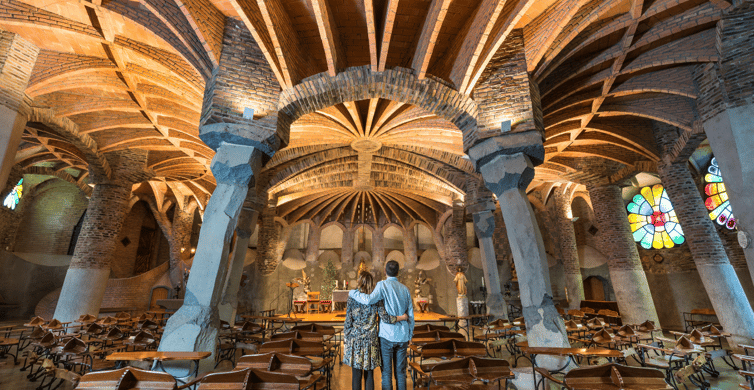
Inside there is not one straight line and not one element that isn't doing structural work. The brick columns lean, each at a different angle, because each is aligned with the exact direction of the load it carries. At the centre, four basalt pillars quarried nearby, their capitals barely dressed, take the springing of the vaults. Overhead are hyperbolic paraboloid vaults in bare brick that open like rough fans — unplastered, materials left visible.
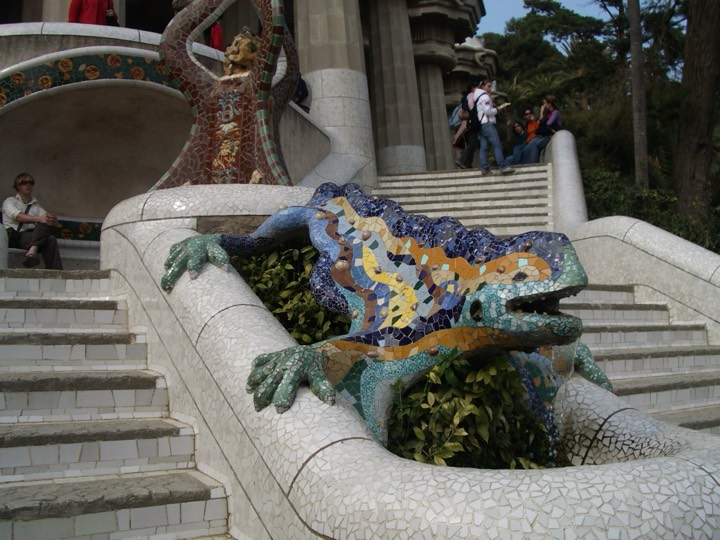
Then there is the colour. The windows open in the shape of flowers and butterfly wings, glazed in yellow, blue and green over lead, and the frames and grilles are clad in trencadís, the broken ceramic Gaudí would later take to the wave bench at Park Güell. The wooden and wrought-iron pews inside are his design too. The exterior porch, with its fanning arches and the mosaic of the four Evangelists, is where most visitors stop before going in.
UNESCO added the crypt in 2005 to the "Works of Antoni Gaudí" inscription, alongside Casa Vicens, Casa Batlló and the Nativity façade of the Sagrada Família. Of the seven protected works, it is the only one outside the city.
The whole village, and it's free to walk
Here is the part almost nobody mentions: the crypt is the crowning piece of a fully preserved Modernista industrial village, and its streets are public. There is no gate into the colony. You can step off the train, walk around for an hour and go home without paying anything.
Güell founded the colony in 1890 on his Can Soler de la Torre estate at Santa Coloma de Cervelló, moving the textile business he ran in Sants out of Barcelona and away from the labour unrest of the day. His plan was not a factory with dormitories attached: he wanted a self-sufficient community. He built workers' housing, a school, a consumer co-operative, a cultural centre with a theatre — the Centre Cultural Sant Lluís — plus a doctor's house, a teacher's house and managers' villas such as Ca l'Espinal and Ca l'Ordal.
None of it is Gaudí's. It was signed by his collaborators: chiefly Francesc Berenguer i Mestres and his son Francesc Berenguer i Bellvehí, along with Joan Rubió i Bellver. All of it Modernista bare brick, with pointed arches, sgraffito and ceramic, in a complex that is still lived in. The factory closed in 1973; the industrial sheds were repurposed and the houses are still houses, with residents, parked cars and washing on the line. Walk with the discretion that implies.
Getting there by train from Barcelona
The train. It leaves from the FGC station at Plaça d'Espanya — not the metro: look for the orange Ferrocarrils de la Generalitat gates on the lower level — on the Llobregat-Anoia line, to the Colònia Güell stop. The official website lists lines S3, S4, S8 and S9 and puts the trip at "just 20 minutes"; in practice allow 20 to 25 minutes depending on the train, with roughly one departure every 15 minutes during the day. Some guides and older signage still mention an S33: read the platform screens and board whichever train lists Colònia Güell among its stops.
The walk. Off the train, cross the road and follow the blue footprints painted on the pavement. They lead straight to the visitor centre, where tickets are sold, in about five to ten minutes; the crypt sits a little beyond it, on higher ground. Budget around 10 minutes from station to crypt. The route is flat and signposted but entirely in the open — in July and August, bring water and a hat.
The fare. Santa Coloma de Cervelló is one of the 36 municipalities of the Barcelona Metropolitan Area and, according to atm.cat, the metropolitan fare lets you travel between those 36 municipalities on single-zone integrated tickets, FGC included. A zone 1 T-casual therefore covers the round trip with no supplement. Some older maps still label the station zone 2B, so if you are buying a single ticket, check the amount on the machine. If you don't have a travel card yet, our Barcelona transport guide compares all the options.
By car. Take the B-23 and A-2 towards Sant Boi de Llobregat, about 20 to 25 minutes without traffic, and there is free parking beside the colony. That said, the train is faster at rush hour and spares you driving back into Barcelona.
Timing, how long it takes and the best light
Watch the weekend closing time. This is planning mistake number one: the crypt opens 10:00 to 17:00 on weekdays, but on Saturdays, Sundays and public holidays it closes at 15:00, according to gaudicoloniaguell.org. Leave Barcelona at midday on a Sunday and you will arrive as the doors are shutting. At weekends, catch a train before 12:00.
Quiet hours. Nearly all of them. The bulk of the visitors are school groups and organised tours arriving between 11:00 and 13:00, Tuesday to Thursday. Turn up at 10:00 and you will often have the crypt more or less to yourself. Mondays are very quiet too — and this is the one major Gaudí site that does not close that day.
Time needed. An hour and a half if you head straight for the crypt with the audio guide and take a short loop of the colony. Two hours if you sit and study the vaults and walk the streets properly. Door to door from central Barcelona, trains included, about three and a half hours.
Best light. Inside, the morning. The crypt's stained glass catches the sun so that by mid-morning it throws yellow and blue patches across the brick and the floor, and that is the moment the room looks the way Gaudí intended. For the exterior porch and its fanning arches, low late-afternoon light on a weekday picks out the relief best. Photography inside is fine without flash or a tripod.
Accessibility. This is old village terrain, with gentle slopes and uneven paving in the colony's streets, but the crypt has adapted access. If you travel with a wheelchair, email ahead: the FGC station and the route are manageable, but it is worth confirming the specific itinerary.
How to save money
- The €8 reduced rate: over-65s, young people and students with a card, according to gaudicoloniaguell.org. Carry the supporting document — they do ask at the desk.
- The colony is free: the streets, the school, the co-operative and the cultural centre can all be seen from outside at no cost. If money is tight, the trip is still worth making for the walk alone.
- Don't buy the Combinat Güell if you already have a T-casual: you would be paying for the train twice. With your own card, the standalone €10 ticket is the cheapest route.
- Groups of 20 or more: entry drops to €6.70 per person and the guided tour to €8.90-€9.70. If you are a large family or a club, email ahead to arrange it.
- City passes: at €10 a head, no pass pays for itself on this visit. Compare them in our cards and passes guide on the basis of the Sagrada Família and Casa Batlló, not the crypt.
- The audio guide is included: it comes with the basic ticket, in several languages. There is no need for a private guide unless you want the colony's streets explained, which is exactly what the two-hour guided tour adds.
What to combine it with (and what not to)
Montserrat on the same day: only with a full day. Both trains leave Plaça d'Espanya, both are FGC, so the temptation is obvious. They even run along the same Llobregat-Anoia line in the same direction, but they are different trains (S3, S4, S8 or S9 for Colònia Güell; the R5 towards Manresa for Monistrol) and go very different distances: Colònia Güell is 20 minutes out, Monistrol de Montserrat about an hour, plus the rack railway or cable car up the mountain. Chaining them means a 7:30 start, exactly three hours at Montserrat, back down the line to Colònia Güell and a race against the clock at the crypt — and at the weekend you simply won't make it, because it closes at 15:00. It is doable on a weekday with discipline, but you will be rushing all day. Give each one a morning if you can. We cover both in Montserrat and in our guide to day trips from Barcelona.
What does fit. A morning at Colònia Güell followed by an afternoon on the city's Gaudí trail works very well, because you arrive at the Sagrada Família knowing where those columns came from. It also pairs with Sant Boi de Llobregat, one stop up the line, if you fancy lunch outside the tourist circuit.
Eating. The colony has a couple of simple places and not much else — it is not a food destination, and off-season some of them close. If your timings are tight, eat before you leave Barcelona or when you get back.
Frequently asked questions
How much does the Colònia Güell crypt cost?
Entry with an audio guide is €10 and the reduced rate €8 for over-65s, young people and students, according to gaudicoloniaguell.org. The two-hour guided tour of the crypt and the colony is €13 (€10.20 reduced), and the Combinat Güell, which adds the return train from Barcelona, is €15.30 (€10.70 reduced). Groups of 20 or more start at €6.70 per person.
How do you get to Colònia Güell from Barcelona?
Take an FGC train from Plaça d'Espanya station on the Llobregat-Anoia line to the Colònia Güell stop. The official website lists lines S3, S4, S8 and S9 and puts the journey at about 20 minutes; in practice allow 20 to 25 minutes depending on the train. When you get off, cross the road and follow the blue footprints painted on the pavement to the visitor centre, a walk of roughly five to ten minutes.
Does a T-casual cover the trip to Colònia Güell?
Yes. Santa Coloma de Cervelló is one of the 36 municipalities of the Barcelona Metropolitan Area and, according to atm.cat, the metropolitan fare lets you make journeys between those 36 municipalities on one-zone integrated tickets, FGC included. So a zone 1 T-casual covers you both ways. Some older maps still label the station as zone 2B, so if you are buying a single ticket, check the price on the machine first.
How long do you need at Colònia Güell?
An hour and a half to two hours on site: around 40 minutes for the crypt and the interpretation centre with the audio guide, and another 40 to 50 minutes walking the colony's streets. Add the train from Plaça d'Espanya and back and you are looking at roughly three and a half hours door to door.
Why was the church never finished?
The Güell family stopped paying for it. Gaudí received the commission in 1898, building work started in 1908 and stopped in 1914 when the funding was cut. Of a design with two superimposed naves, several towers and a central dome of around 40 metres, only the lower nave was ever built. It was consecrated in November 1915 and finished off by another architect between 1915 and 1917. That lower nave is what everyone now calls the crypt.
What was Gaudí's upside-down hanging model?
A 1:10 scale model about four metres tall that Gaudí built in a shed next to the site. He hung a net of strings from the ceiling and suspended small sacks of birdshot from each support point, weighted to reproduce the real loads of the building. Gravity pulled the strings into exact catenary curves, the shape of pure tension. He photographed the whole thing and turned the photograph upside down, and those tension curves became lines of pure compression. No computers, no structural software.
Can you do Colònia Güell and Montserrat in the same day?
You can, but it makes for a long, rushed day. Both trains leave from Plaça d'Espanya on the same FGC line (Llobregat-Anoia) and in the same direction, but they are different services (S3, S4, S8 or S9 for Colònia Güell; the R5 for Montserrat): Colònia Güell is 20 minutes away, Monistrol de Montserrat is about an hour, plus the rack railway or cable car up the mountain. If you attempt both, do Montserrat first thing and leave the crypt for the afternoon, bearing in mind it closes early. With less than a full day, pick one.
Can you walk around the colony without a ticket?
Yes. Colònia Güell is a working village with residents and its streets are public: you can walk freely past the workers' housing, the school, the co-operative and the cultural centre, all Modernista and mostly the work of Francesc Berenguer i Mestres, his son and Joan Rubió i Bellver. What you pay for is access to Gaudí's crypt and the interpretation centre.
Ten euros and twenty minutes on a train
The one Gaudí building where you can still be alone. Lock in your ticket with audio guide — many options come with free cancellation.
See dates and prices