Barcelona: La Pedrera-Casa Milà Ticket & Audio Guide Option
4.7 (29,753 reviews)
from €29Check dates
Three Modernista houses you can go inside — and not one queue — compare prices and hours
Three Modernista houses you can walk through inside, for roughly half what the famous ones charge, with no queue at the door. Here are the official prices, the real opening hours, the route that links all three in a day — and, honestly, who should skip them.
ⓘ Note: this is not the official website This is not the official website of Casa Vicens, Palau Güell or Casa Amatller. We are an independent guide: prices quoted come from casavicens.org, palauguell.cat and amatller.org, and bookings are processed by authorised partners such as GetYourGuide.23 options · Prices checked on 18 October 2026
No options match these filters.
4.7 (29,753 reviews)
from €29Check dates
4.7 (5,839 reviews)
from €24Check dates
4.6 (6,095 reviews)
from €22.50Check dates
4.6 (3,727 reviews)
from €29Check dates
| Price from | Palau Güell €15 · Casa Vicens ~€18 · Casa Amatller ~€21 depending on visit format |
|---|---|
| Opening hours | Casa Vicens daily 9:30-20:00 (to 18:00 November-March) · Palau Güell Tue-Sun 10:00-20:00 (to 17:30 November-March) · Casa Amatller daily 10:00-20:00 |
| Advance booking? | Compulsory only for Palau Güell, which sells online only. Advisable but not critical at the other two |
| Time needed | 45 min - 1 h 15 min each · all three fit into one day with room to spare |
| Metro | Fontana (L3) for Casa Vicens · Liceu or Drassanes (L3) for Palau Güell · Passeig de Gràcia (L2/L3/L4) for Casa Amatller |
| Key fact | Casa Vicens is Gaudí's first house and stayed closed to the public until 2017 |
Here is the whole argument of this page in one line: Casa Vicens and Palau Güell together cost €33, less than a single Silver ticket to Casa Batlló. And you will not queue at either. These are not substitutes for the headline sights — they are what you visit once you have done the headline sights, or when you want real architecture without projections and augmented reality.
| House | Price | Hours | Duration | Who it's for |
|---|---|---|---|---|
| Casa Vicens | General ~€18 · reduced ~€16 · under 11s free | Daily 9:30-20:00 (Apr-Oct) and 9:30-18:00 (Nov-Mar); last entry ~40 min before closing | 1 h - 1 h 15 min | Anyone who wants to see Gaudí's starting point, before he was "Gaudí" |
| Palau Güell | General €15 · reduced €12 · mini €5 (13-18s and students) · under 13s free | Tue-Sun 10:00-20:00 (Apr-Oct) and 10:00-17:30 (Nov-Mar); closed Mondays | 1 h - 1 h 15 min with audio guide | Architecture lovers and anyone already walking down La Rambla |
| Casa Amatller | ~€21-25 general depending on format · reduced youth rate · under 7s free | Main floor daily 10:00-20:00; video-guided visits every 30 min from 10:00 to 19:00 | 40 min video-guided · ~1 h guided | Anyone already on Passeig de Gràcia who wants original interiors |
Rates published by casavicens.org, palauguell.cat and amatller.org, checked in August 2026. Casa Amatller sells several visit formats (video-guided, guided, dramatised, photographic studio) at different prices and with seasonal promotions: confirm the exact amount on amatller.org before booking.
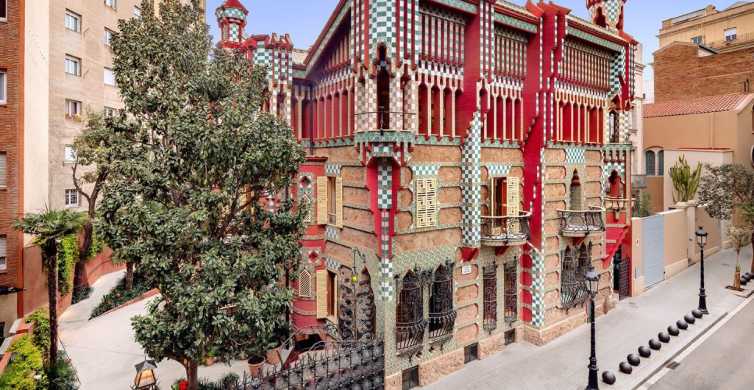
In 1883 Antoni Gaudí was 31, had no significant building to his name, and took a small commission: a summer house in Gràcia — then an independent town ringed by market gardens — for Manuel Vicens i Montaner, a stock and currency broker. Gaudí finished it in 1885, and what he built resembles nothing he did afterwards and nothing that existed in Barcelona at the time.
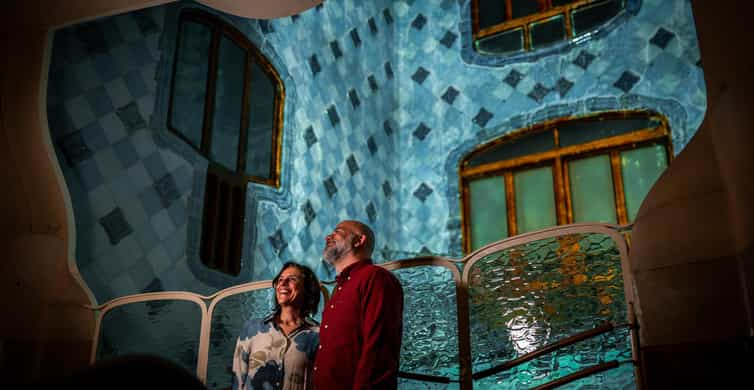
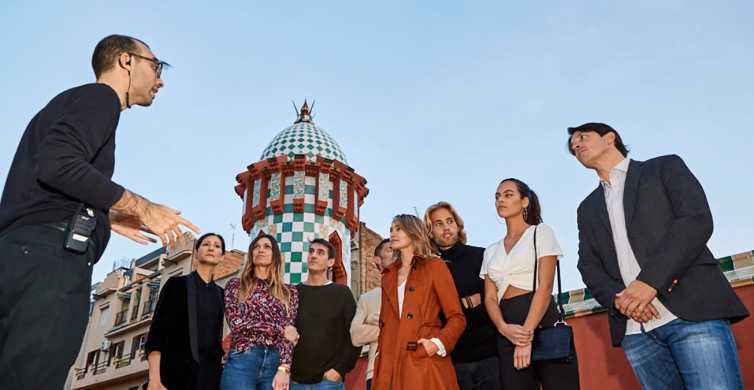
Casa Vicens is Mudéjar and Moorish: horizontal bands of bare brick and ceramic, turrets capping the corners, wrought-iron palm-leaf railings and, above all, green-and-white tiles carrying a yellow marigold — the flower said to have grown on the plot — repeated in panels that climb the façade like tapestry. Gaudí had not yet invented his structural curve; what he had here was colour, geometry and surface. Inside, the dining room with its painted vegetal frieze, the smoking room under a muqarnas-style vault and the first-floor gallery explain, better than any book, where Park Güell and the Sagrada Família came from.
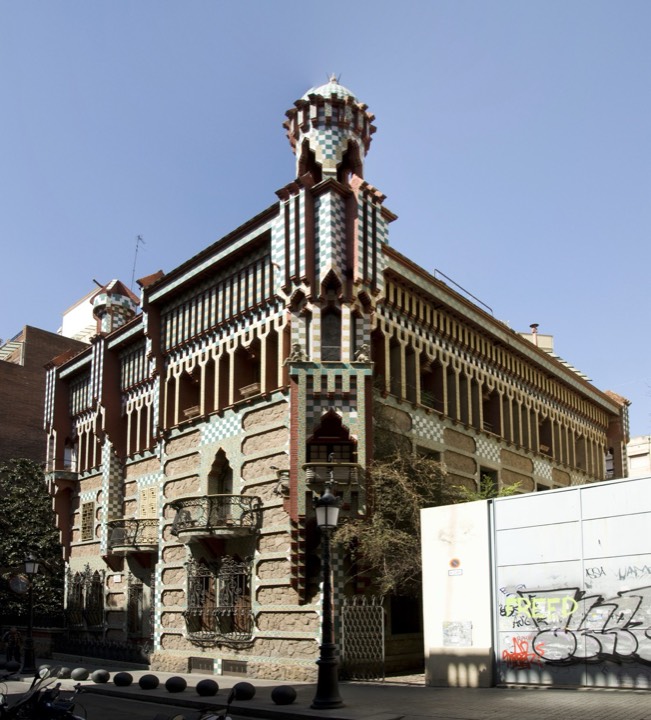
The house stayed a private home for more than 130 years. UNESCO added it in 2005 to the "Works of Antoni Gaudí" listing, and only in November 2017, after an Andorran bank bought it and a long restoration finished, did it open as a house museum. That is why it is missing from most three-day itineraries: it has been open for less than a decade and it sits on Carrer de les Carolines, a narrow street no tour bus passes. Admission includes the audio guide and the temporary exhibitions, and same-day slots are usually available.
Three years after Casa Vicens, the industrialist Eusebi Güell i Bacigalupi commissioned Gaudí to build an urban palace on Carrer Nou de la Rambla, fifty metres off La Rambla and deep in the Raval, then a rough neighbourhood. It is the first major product of the architect-patron relationship that would later produce Park Güell and the Colònia Güell. It went up between 1886 and 1890 and was the first work by Gaudí to be inscribed as a UNESCO World Heritage Site, in 1984.
The visit begins on the street, in front of the two parabolic arches of the entrance, closed by wrought-iron gates that carriages once drove through; between them sits the Catalan coat of arms. The horses went down a spiral ramp to the basement stables, a forest of brick pillars with mushroom-shaped capitals that is the most startling space in the building — and the first one you see.
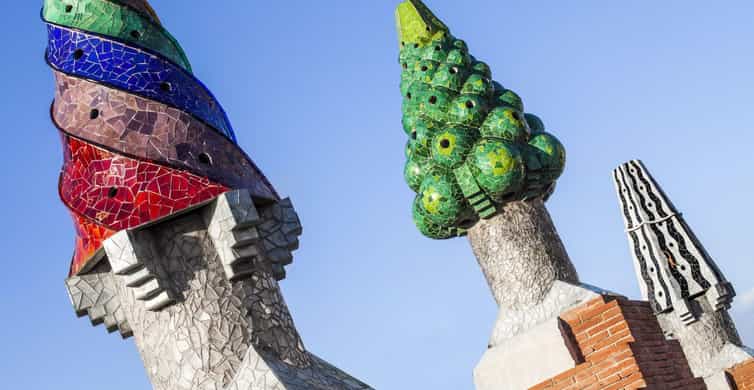
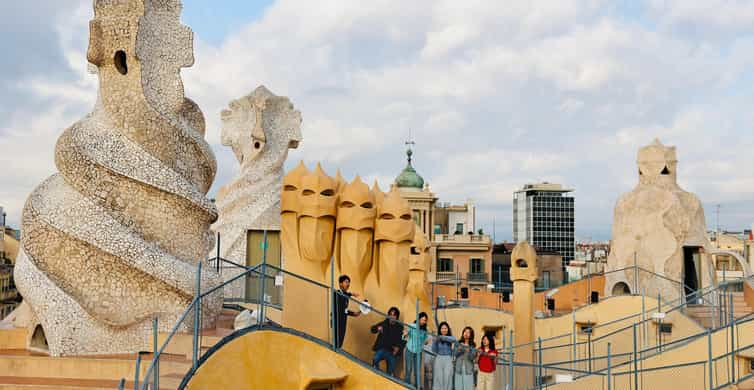
The heart of the house is the central hall, a room three storeys high crowned by a parabolic dome punched with dozens of circular holes. In daylight, with light coming through those openings and the lamps lit around them, the ceiling reads as a starry sky: this was the room for receptions and concerts, and its organ pipes still sound during visits. The roof completes the logic: twenty chimneys and ventilation towers clad in ceramic and glass trencadís, a catalogue of shapes Gaudí would carry, fifteen years later, up to the warrior chimneys of La Pedrera.
General admission €15, reduced €12 and a mini rate of €5 for students and young people aged 13-18; free for under-13s, according to palauguell.cat. It opens Tuesday to Sunday, 10:00-20:00 from April to October and until 17:30 from November to March, closes on Mondays, and admission is free on the first Sunday of the month. Tickets are sold online only — there is no ticket desk to fall back on, so buy before you turn up.
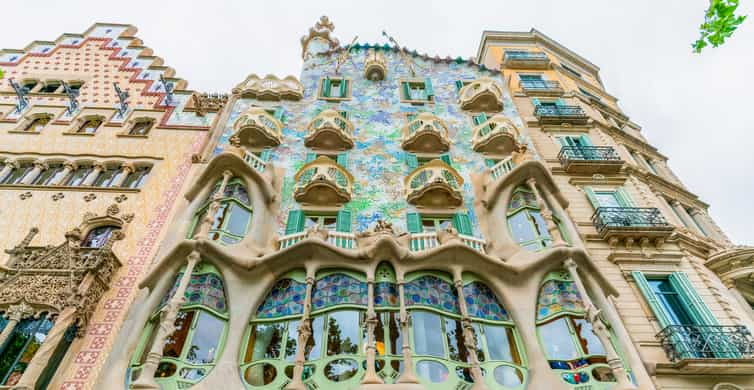
It shares a wall with Casa Batlló, and most people photograph it and walk on. This is the house Josep Puig i Cadafalch remodelled between 1898 and 1900 for Antoni Amatller i Costa, chocolate industrialist, amateur photographer and art collector. Its façade is a stepped gable of Flemish inspiration — Puig i Cadafalch came out of central European neo-Gothic — with pink sgraffito, glazed ceramic and sculptures by Eusebi Arnau in which stone animals make chocolate, blow glass and take photographs: the owner's trade and hobbies, carved beside his own front door.
What sets it apart from its neighbours is the inside. Casa Amatller is the only house on the Block of Discord that still has the family's original interiors: furniture by Gaspar Homar, the stained glass of the dining room, the library, the glass collection and, on the upper floor, the photographic studio where Antoni Amatller and his daughter Teresa made thousands of plates. There is no digital reconstruction and no immersive room — just a 1900 bourgeois house left as it was.
According to amatller.org, the main floor opens daily 10:00-20:00 (closed 25 and 26 December and 6 January). There are guided tours at 10:00 in English, 11:00 in Spanish and 12:00 in Catalan; a video-guided visit of about 40 minutes every half hour between 10:00 and 19:00; a photographic studio tour on weekend afternoons; a dramatised tour at weekends; and an Amatller chocolate tasting on Fridays at 18:00, made to the company's original recipe. Some formats include chocolate and some do not, so read what you are buying.
Casa Lleó i Morera (Passeig de Gràcia 35). The third corner of the Block of Discord, built by Lluís Domènech i Montaner between 1902 and 1906, with a gallery sculpted by Eusebi Arnau and an extraordinary Modernista interior. The catch: the interior is closed to general visitors and only opens for occasional guided visits — Barcelona Cultura programmes, the 48H Open House festival — announced at short notice. Plan on seeing it from the pavement and treat any interior visit as a bonus. Check before making a trip for it.
Torre Bellesguard (Carrer de Bellesguard 16-20, on the lower slopes of Tibidabo). Gaudí's strangest house, built between 1900 and 1909 on the ruins of the medieval residence of Martí l'Humà, the last king of the House of Barcelona: sharp neo-Gothic, walls of slate and schist quarried on site, and a viaduct of leaning arches in the garden. It opens Tuesday to Sunday 10:00-15:00, with last entry around 14:00, and guided tours cluster from Thursday to Sunday in small groups; the guided visit runs about €15 and the gardens-and-exterior ticket about €7. It is a long way from the centre — FGC to Av. Tibidabo, then a solid uphill walk — so it only makes sense if you are heading to Tibidabo the same day. Verify hours at bellesguardgaudi.com.
Quiet hours. The point of these houses is that they barely have bad hours. Even so: Casa Vicens is emptiest on weekday mornings, before school groups arrive; Palau Güell fills up mid-morning with people drifting off La Rambla, so aim for the 10:00 opening or the last two hours of the afternoon; and Casa Amatller peaks around midday, when the Casa Batlló queue spills onto the pavement next door.
Days. Palau Güell closes on Mondays — planning mistake number one on this route. The first Sunday of the month is free and, predictably, the busiest day of the month: skip it if you want quiet, go at opening time if you want to save.
Best light. Casa Vicens is a morning building: raking sun picks out the relief in the brickwork and saturates the greens in the ceramic. Casa Amatller and the rest of Passeig de Gràcia work the other way round — the façades get afternoon light and are well lit after dark. Palau Güell has no possible façade shot at all; the street is too narrow to step back. Save the battery for the hall and the roof.
Who should skip them. Let's be blunt: if this is your first trip to Barcelona and you have one day, do not come here. Spend that day on the Sagrada Família and Park Güell, which have no equivalent anywhere else. With two days, add Casa Batlló or La Pedrera. These three houses are for day three, for a second trip, for travellers on a tight budget, or for anyone who has had enough of queues. They are also not a young-children plan: no projections, no screens, no dragon rooftop — just furniture, ceramic and quiet.
Casa Vicens. Metro Fontana (L3), five minutes downhill along Gran de Gràcia and then right; Lesseps (L3) works too. It is about a 15-minute walk from the main Park Güell entrance, downhill from the park, which makes that pairing the most natural of the day.
Palau Güell. Metro Liceu (L3) or Drassanes (L3), both under five minutes away. From Liceu you cross La Rambla and turn into Carrer Nou de la Rambla; the Gothic Quarter is directly on the other side of the boulevard.
Casa Amatller. Metro Passeig de Gràcia (L2, L3, L4), Aragó exit. It is at number 41, wall to wall with Casa Batlló, a ten-minute walk from Plaça de Catalunya.
The one-day route that works. Start at 10:00 at Casa Amatller, while Passeig de Gràcia is still calm and the Casa Batlló queue has not fully formed. Walk down to Plaça de Catalunya (10 minutes) and continue along La Rambla to Palau Güell (another 10-12 minutes), with a Boqueria stop if you hit lunchtime. Eat one street back, in the Raval or the Gòtic. In the afternoon, take the L3 from Liceu to Fontana for Casa Vicens; if you still have legs, climb up for sunset around Park Güell. Total: three houses, roughly €54 in tickets, zero queues.
Accessibility. All three are historic buildings with stairs. Casa Vicens and Palau Güell have lifts and adapted routes over most of the itinerary, with limits on roofs and mezzanines; Casa Amatller is a 1900 house with the restrictions that implies. Email the house before you go if you travel with a wheelchair — they reply, and they adjust the visit.
Casa Vicens, on Carrer de les Carolines in the Gràcia district, built between 1883 and 1885 as a summer house for the stock and currency broker Manuel Vicens. It is Antoni Gaudí's first major house, earlier than Palau Güell and everything he later did on Passeig de Gràcia. It stayed a private home until it opened to the public in November 2017.
General self-guided admission is around €18 and the reduced rate around €16 (students aged 12-25, over-65s, large and single-parent families, visitors with disabilities), with free entry for children under 11, according to casavicens.org. The ticket includes an audio guide and the temporary exhibitions. Check the day's rate on the official site before you buy.
General admission €15, reduced €12 and a mini rate of €5 for students and young people aged 13-18, free for under-13s, according to palauguell.cat. It opens Tuesday to Sunday from 10:00 to 20:00 between April and October and until 17:30 from November to March; closed Mondays. Entry is free on the first Sunday of the month and tickets are sold online only.
Not the way you need to for the Sagrada Família. Palau Güell sells online only, so you have to book, although same-day slots are usually available. Casa Vicens and Casa Amatller rarely sell out except on long weekends and in August. Booking the night before still saves you the ticket-desk queue and locks in the slot you want.
Yes, and it is the only house on the Block of Discord that keeps the family's original interiors. Several formats are offered: guided tours at 10:00 in English, 11:00 in Spanish and 12:00 in Catalan, a video-guided visit every 30 minutes from 10:00 to 19:00, a photographic studio tour on weekend afternoons and an Amatller chocolate tasting on Fridays at 18:00. The main floor is open daily 10:00-20:00, according to amatller.org.
No. With a single day, the Sagrada Família and Park Güell are the visits nothing else replaces; these three houses are a reward for day two or three, or for a return trip. That said, if you are going to be on Passeig de Gràcia anyway, Casa Amatller slots into an hour without breaking the plan.
Palau Güell if you care about architecture: €15 buys an entire Gaudí palace, with the starry-dome hall and a roof of trencadís chimneys that prefigures La Pedrera, fifty metres off La Rambla. Casa Vicens if you want to understand where Gaudí came from. Casa Amatller if you are already on Passeig de Gràcia with an hour to spare.
Yes, comfortably. Each visit takes between 45 minutes and 1 hour 15 minutes and the hops are short: Casa Amatller and Casa Vicens sit on the same metro line (L3, Passeig de Gràcia and Fontana), and it is a 15-minute walk from Passeig de Gràcia down to Palau Güell. The order that works best is Amatller mid-morning, Palau Güell around midday and Casa Vicens in the afternoon, near Park Güell.
Casa Vicens is the one Gaudí house you can still visit almost alone. Lock in your slot — many options come with free cancellation.
See dates and prices