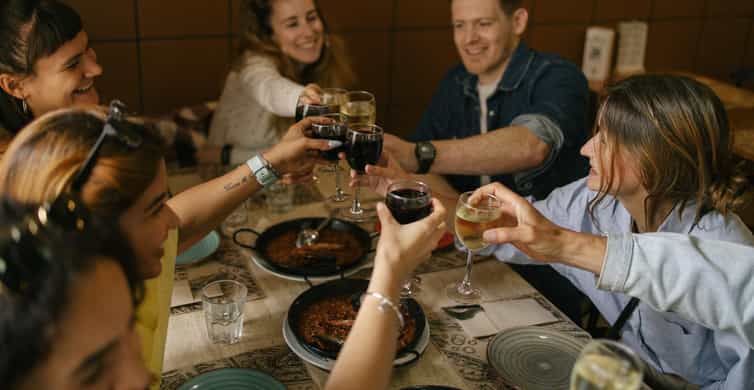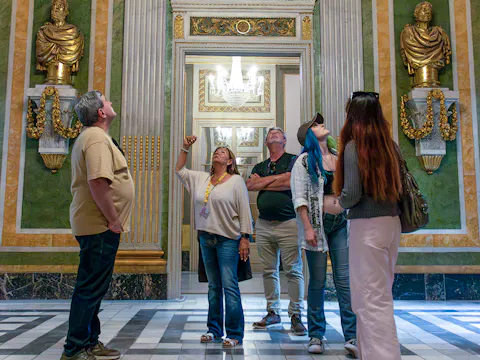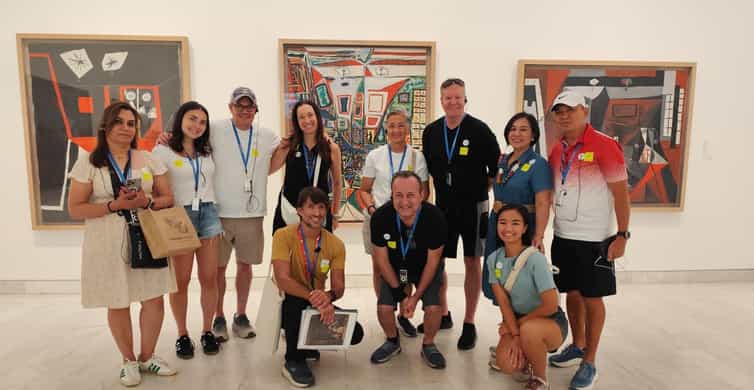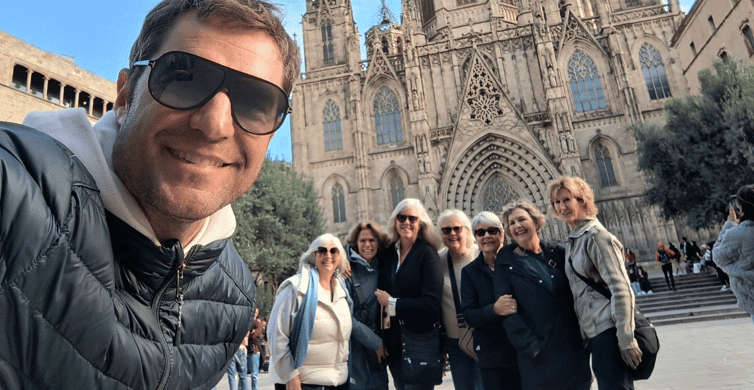
Barcelona: Tapas Walking Tour with Food, Wine, and History
4.8 (5,535 reviews)
from €52.80Check dates
Most people take the same photo at the Pont del Bisbe and leave: the full route is 2–3 hours — see the ten stops
The Barri Gòtic fits inside a rectangle roughly 800 by 500 metres — and inside it are the Roman wall, the cathedral, a medieval Jewish quarter, two seats of government and the first street lamps Gaudí ever designed. Here is the route stop by stop, with the opening hours that matter, when a guide actually earns its price, and honest advice about pickpockets.
ⓘ Note: this is not an official website This is not an official website of Barcelona City Council or of any museum in the quarter. We are an independent guide: prices and opening hours quoted here come from the official sites (barcelona.cat, basilicadelpi.cat, macba.cat), and tour bookings are processed by authorised partners such as GetYourGuide.24 options · Prices checked on 18 October 2026
No options match these filters.
4.8 (5,535 reviews)
from €52.80Check dates
4.7 (2,084 reviews)
from €20.31Check dates
4.7 (1,651 reviews)
from €13.30Check dates
4.7 (1,334 reviews)
from €66.75Check dates
4.6 (1,365 reviews)
from €199.99Check dates
4.6 (44 reviews)
from €109Check dates
| Price | Walking it is free · guided walking tours from around €20 per person, depending on operator and language |
|---|---|
| Opening hours | The streets never close · monuments run roughly 10:00 to 19:00–20:00 |
| Advance booking? | Not to walk it. Yes for small-group tours and the evening legends tour, which sell out in summer |
| Time needed | 2–3 h for the full loop without going inside · 5–6 h with the cathedral, MUHBA and lunch |
| Metro | Jaume I (L4 yellow) in the middle of the quarter · Liceu (L3) off La Rambla · Urquinaona (L1/L4) to the north |
| Key fact | Around 4,000 m² of Roman streets survive under Plaça del Rei and can be walked (MUHBA) |
The Barri Gòtic is small and full of dead ends, so the order matters: done in this direction the walk never doubles back and finishes on La Rambla with a metro station at hand. Allow 2 to 3 hours at an unhurried pace, not counting time inside monuments.
There is no ticket to buy here: the quarter is a public street. The real question is whether to pay someone to explain it. The honest answer: to stroll and take photos, you don't need to; to understand what you are walking on, you do. The two most interesting layers of the Barri Gòtic — the Roman city and the Jewish quarter — are literally invisible without someone pointing out where to look. A reused wall block, a stone with Hebrew lettering, a bricked-up arch: on your own you walk straight past all of them.
| Option | Approx. price | Length | Best for |
|---|---|---|---|
| Self-guided with this route | Free | 2–3 h | Travellers with time, repeat visitors, and anyone who wants to stop and shoot without a group's pace. |
| Old Town & Gothic Quarter tour | from ~€20 | ~2 h | A first visit: Roman, medieval and present-day context in one guided walk. |
| Guided 10-attraction route | varies by operator | ~2–2.5 h | Tight schedules — a guarantee you won't miss any of the main stops. |
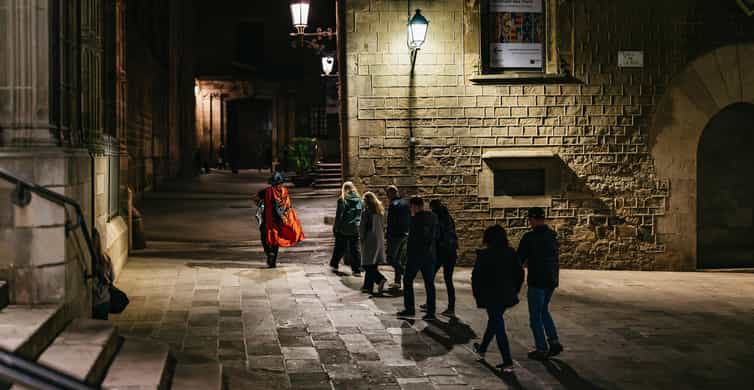
| Ghosts and legends tour | varies by operator | ~1.5–2 h | After dark, with teenagers, or on a second trip: the quarter empty and in a different register. |
| El Raval street art tour | varies by operator | ~2 h | Anyone who has done the Gothic bit and prefers contemporary Barcelona across La Rambla. |
Third-party tour prices are indicative and vary by language, group size and season. Check the exact figure in the search box above before booking.
The Gòtic ends the moment you cross an avenue. These four districts are minutes away, and each one changes the kind of day you're going to have.
Cross Via Laietana and you're in El Born, the part of Ciutat Vella many people end up preferring. Its anchor is Santa Maria del Mar (1329–1383), the church behind the novel Cathedral of the Sea: built in just 55 years, and coherent in a way the cathedral, with its centuries of building works, never manages. Beside it, Carrer de Montcada lines up medieval palaces turned into museums — the Museu Picasso, strongest on the artist's formative Barcelona years, and the Moco Museum, with Banksy, Kusama and contemporary work in a 16th-century palace. It's also the district for eating and drinking vermouth away from the chains: if that's the plan, see our food tours guide.
On the other side of La Rambla, El Raval is Barcelona's most mixed district: the MACBA and its plaza colonised by skateboarders, Botero's bronze cat on Rambla del Raval, Sant Pau del Camp (the oldest Romanesque church in the city) and Gaudí's Palau Güell on Carrer Nou de la Rambla. MACBA is free on Thursdays, Fridays and Saturdays from 18:00 to 20:00 and on the first Sunday of the month (macba.cat). The honest note: by day it is perfectly normal and well worth your time, but in the small hours the southern streets towards the port have a deserved reputation for theft and dealing. Stick to the main streets, skip the back lanes at three in the morning, and don't walk through with a camera swinging. To see it with some context, there's a Raval street art and graffiti walking tour that covers the murals and who painted them.
Twenty minutes by metro (L3 to Fontana) or half an hour on foot up Passeig de Gràcia. Gràcia was an independent municipality until 1897 and still behaves like one: pedestrian streets, squares full of locals rather than queues — Plaça de la Vila de Gràcia, Plaça del Sol, Plaça de la Virreina — and not a single ticketed monument. Go mid-afternoon with no plan. In August, the Festa Major de Gràcia fills the streets with elaborate decorations built by the residents themselves. From here it's a 20-minute uphill walk to Park Güell.
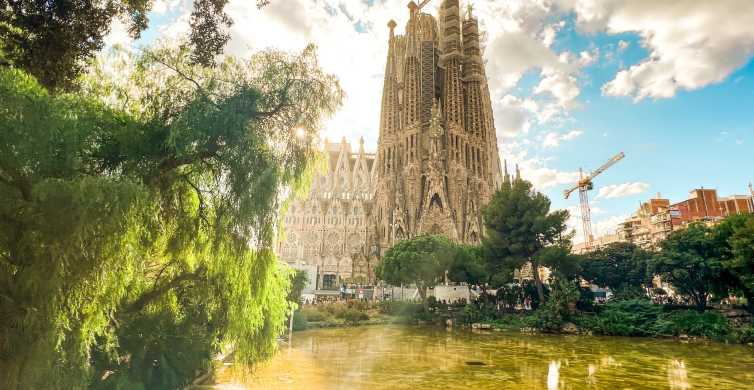
If the Gòtic is medieval chaos, the Eixample is its exact opposite: the grid Ildefons Cerdà laid out in 1859, with its chamfered street corners. It's where Modernisme lives — Casa Batlló, La Pedrera, the Sagrada Família — and where you walk the Gaudí route. Sensible plan: medieval morning in the Gòtic, Modernista afternoon in the Eixample. They're two metro stops apart.
Barcelona has little street violence and a great deal of theft. Nobody is going to hurt you; they are going to empty your pocket without you noticing. The hotspots are all in this part of town:
What actually works, in order of effectiveness: phone and wallet in a front pocket or a zipped cross-body bag worn in front; backpack on your chest in the metro and in any crowd; nothing valuable in back pockets; bag on your lap, never on the chair; and automatic suspicion of anyone approaching with a map, a petition, a "free" bracelet or a bottle in hand. Leave a spare card at the hotel and keep a photo of your passport on your phone. Do that and the odds of anything happening drop close to zero.
Metro. Jaume I (L4 yellow) drops you in the heart of the quarter, three minutes from the cathedral and Plaça del Rei. Liceu (L3 green) is the door from La Rambla and the closest stop to Plaça Reial and El Call. Urquinaona (L1/L4) works for entering from the north. From Plaça de Catalunya it's a 10-minute walk down Avinguda del Portal de l'Àngel, a pedestrianised shopping street.
Where to start and finish. Begin at Plaça Nova, beside the Roman towers: it's the point where the quarter makes chronological sense, and where guided tours tend to meet. Finish at Plaça Reial, which opens straight onto La Rambla, Liceu metro and somewhere to sit down. If you'd rather end with a meal, carry on 10 minutes to Santa Maria del Mar and El Born.
Bus and bike. Don't drive in: the quarter is a restricted-access zone with nowhere to park. The hop-on hop-off bus stops at Plaça de Catalunya and Port Vell, both under 10 minutes' walk from either end of the route.
The Barri Gòtic is essentially flat — the only rise is Mont Tàber, the 16-metre mound under Plaça Sant Jaume on which Barcino was founded. The real obstacle is the surface: cobbles, uneven slabs and lanes with no pavement, shared with scooters and delivery trolleys. A wheelchair or stroller can do it, but slowly, and ideally first thing in the morning when there's no flow of people through three-metre streets. Monuments vary a lot: the MUHBA and the Museu Picasso are adapted, whereas the Santa Maria del Pi bell tower is a hundred-odd spiral steps with no lift. Check lift availability at Jaume I station on tmb.cat before you set out.
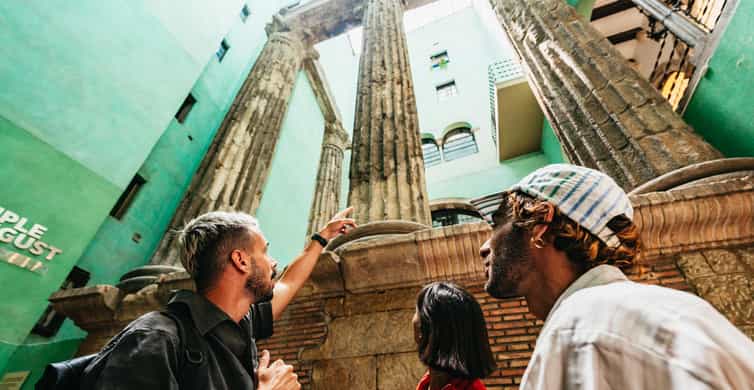
What we now call the Gothic Quarter is really three cities stacked on top of each other. The first is Barcino, the colony Rome founded around 10 BC on the low mound of Mont Tàber: a walled rectangle with two main streets crossing where Plaça Sant Jaume is today. What survives are the towers on Plaça Nova, stretches of 4th-century wall, the four columns of the Temple of Augustus hidden in a courtyard at Carrer Paradís 10 (free entry, it's a MUHBA site) and whole streets preserved under Plaça del Rei.
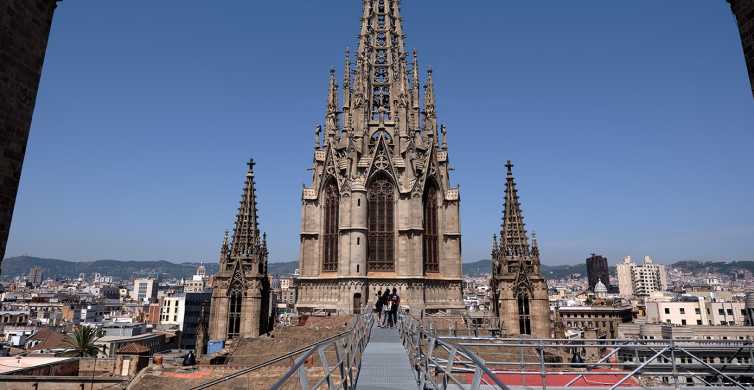
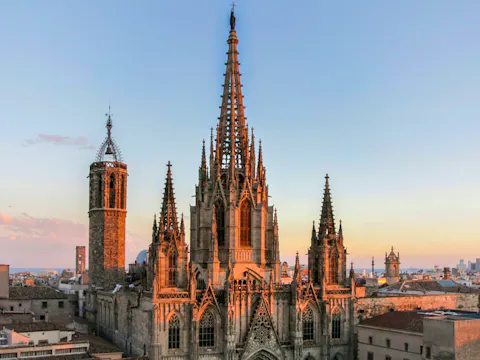
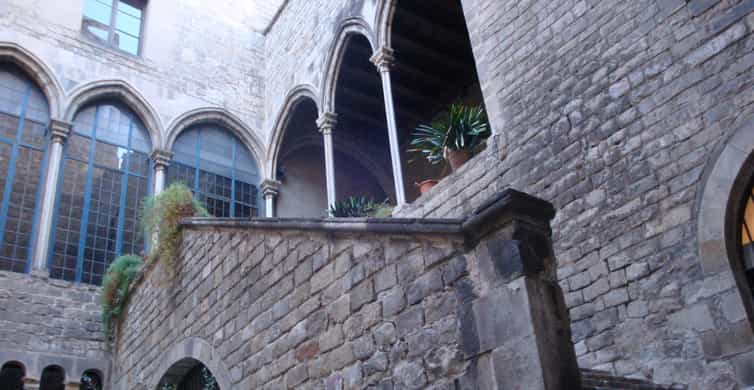
The second is the medieval city that made Barcelona rich: between the 13th and 15th centuries came the cathedral, the Palau Reial Major, the royal shipyards and the Saló del Tinell, while El Call grew into one of the densest Jewish quarters in Europe — until the assault of 1391 wiped out the community and almost all of its buildings. That's the layer the district is named after.
And the third is the one hardly anyone expects: a good deal of the quarter's "medieval" appearance dates from the 20th century. The name Barri Gòtic itself caught on in the 1920s, when the city council set about giving Barcelona an old town worthy of the 1929 International Exposition. That is when the Pont del Bisbe went up (1928), when the Casa Padellàs was moved stone by stone to Plaça del Rei — where it now forms the MUHBA entrance — when neo-Gothic façades were added and the aqueduct arches rebuilt. It isn't a fraud; it's one more historical layer, left by a city deciding how it wanted to be remembered. Knowing it takes nothing away from the walk. It adds a good question on every corner: is this 14th century, or 1928?
The ten-stop loop takes 2–3 hours without going inside anything. Add the cathedral, the MUHBA and a lunch stop and it becomes a long half-day: 5–6 hours.
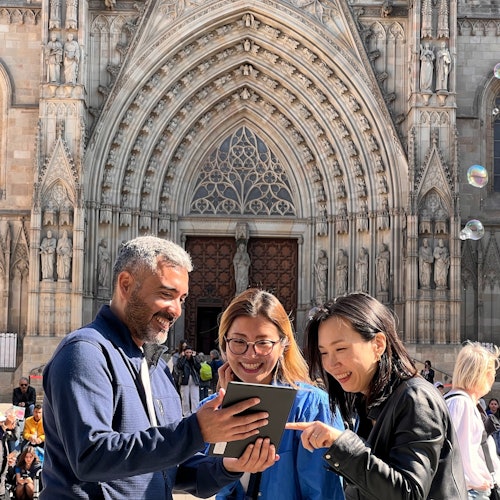
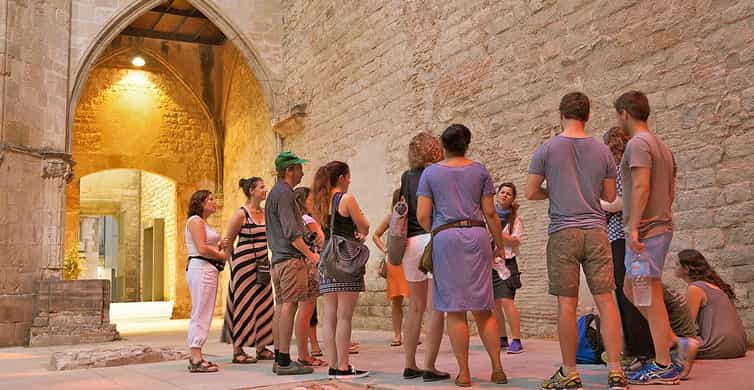
To stroll and take photos, no. It earns its price if you want the quarter's two invisible layers: Roman Barcino and El Call, the Jewish quarter, which without explanation are just stones and plaques. Tours run 2–3 hours and usually show you courtyards you'd walk straight past on your own.
No. It dates from 1928, designed by Joan Rubió i Bellver, a pupil of Gaudí, to link the Palau de la Generalitat with the Casa dels Canonges. Much of the quarter's medieval atmosphere was built or restored between 1900 and 1960.
Scars from the bombing of 30 January 1938. Two bombs fell: the first on the church, whose basement was an air-raid shelter, the second while survivors were being pulled from the rubble. Forty-two people were killed, most of them children, according to the city council's memorial plaque. It's a site of remembrance — visit it quietly.
Yes. The MUHBA at Plaça del Rei preserves roughly 4,000 m² of Barcino — streets, dyeing workshops, a laundry and a winery — crossed on raised walkways. General admission is around €5 per barcelona.cat/museuhistoria, free on the first Sunday of the month and other Sundays from 15:00. The Temple of Augustus columns (Carrer Paradís 10) are free.
Yes in terms of violence; the issue is theft. La Rambla, metro entrances and line L3 account for most of it. Keep your phone and wallet in front, nothing on the back of your chair, and be wary of anyone approaching with a map or a petition.
Start at Plaça Nova, beside the Roman towers, 10 minutes from Plaça de Catalunya down Portal de l'Àngel. Finish at Plaça Reial, which opens onto La Rambla and Liceu metro (L3). Guided tours usually meet at Plaça Nova, at the cathedral or at Plaça de Catalunya.
The quarter is flat, but the surface is uneven cobblestone and many lanes have no pavement. It's doable with patience; go first thing, before the crowds. Closest metro is Jaume I (L4) — check lift availability at tmb.cat.
Two- to three-hour Old Town walking tours, with free cancellation on most options. And if you want to get inside its monuments, start with the cathedral.
See dates and prices