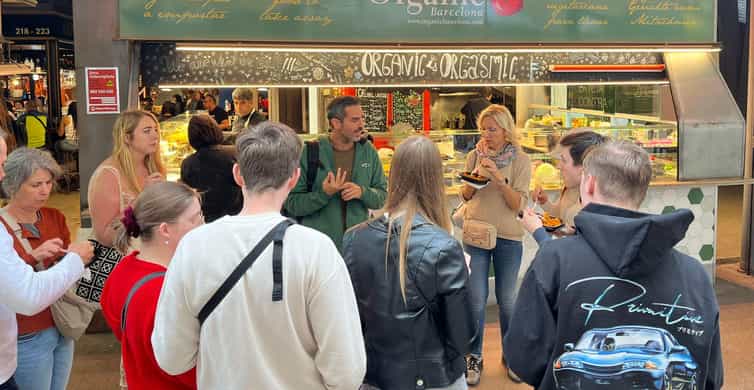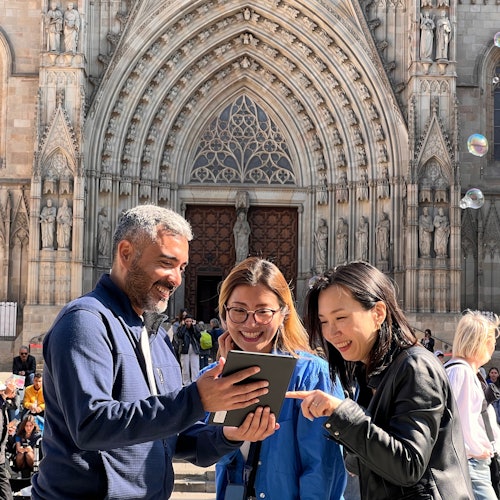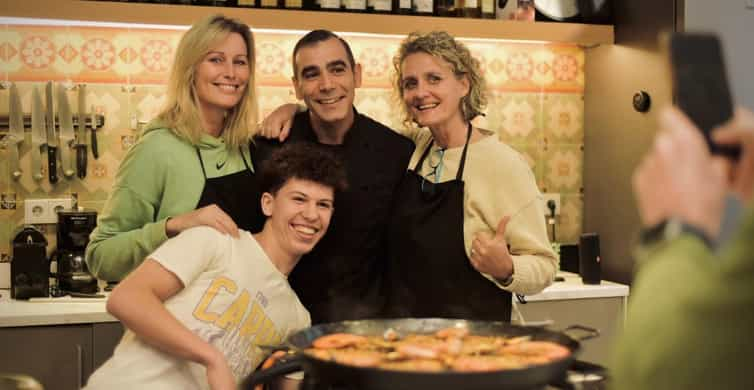
Barcelona: Paella Cooking Experience & Boqueria Market Tour
4.8 (4,382 reviews)
from €59.25Check dates
La Boqueria at 9:00 and at 12:00 are two different markets: one belongs to the city, the other is a queue — how to visit it properly
It is 1.2 kilometres long, it has five named sections, and Europe's most famous food market sits in the middle of it. It is also the street Barcelonans go out of their way to avoid — and there are specific reasons for that. Here is the walk section by section, the Boqueria from the inside with times and traps, and how to enjoy La Rambla without falling for any of them.
ⓘ Note: this is not an official website This is not an official website of Barcelona City Council, the Mercat de la Boqueria or the Gran Teatre del Liceu. We are an independent guide: prices and opening hours quoted here come from the official sites (boqueria.barcelona, barcelona.cat, palauguell.cat, liceubarcelona.cat), and tour bookings are processed by authorised partners such as GetYourGuide.24 options · Prices checked on 18 October 2026
No options match these filters.
4.8 (4,382 reviews)
from €59.25Check dates
4.7 (2,084 reviews)
from €20.31Check dates
4.7 (1,651 reviews)
from €13.30Check dates
4.6 (44 reviews)
from €109Check dates
4.7 (1,334 reviews)
from €66.75Check dates
4.6 (1,365 reviews)
from €199.99Check dates
4.5 (27 reviews)
from €54Check dates
5.0 (7 reviews)
from €30Check dates
3.8 (20 reviews)
from €23Check dates
4.3 (9 reviews)
from €89Check dates
| Price | Walking it and entering the market are free · guided walking tours from around €25 · food tours with tastings from around €70 |
|---|---|
| Opening hours | La Rambla never closes · Mercat de la Boqueria, Monday to Saturday 8:00–20:30, closed Sundays (boqueria.barcelona) |
| Advance booking? | Not to walk it. Yes for food tours and cooking classes, which run in small groups and sell out days ahead |
| Time needed | 20 min end to end · 1.5–2 h with real stops · half a day if you add the Liceu, Palau Güell or an unhurried market visit |
| Metro | Catalunya (L1/L3) at the top · Liceu (L3) in the middle, right at the Boqueria · Drassanes (L3) at the bottom, by the Columbus Monument |
| Key fact | La Boqueria is documented from 1217 as an open-air market; the iron structure you see today was completed in 1914 |
Locals say "les Rambles", plural, and it isn't an affectation: the boulevard is five distinct sections, each named after the convent or institution that once stood beside it before the city pulled them down in the 19th century. Walk it downhill, from Plaça de Catalunya towards the sea. It's easier, the morning light comes at you head-on, and you finish next to the harbour with a metro station right there.
The first hundred metres, just off Plaça de Catalunya. The Font de Canaletes is a small, easily missed iron drinking fountain on the right, and it carries Barcelona's most repeated superstition: drink from it and you will come back to the city. It is also where Barça fans have gathered to celebrate titles for decades, so if the team wins something this stretch becomes an entirely different place. Beyond the fountain and the retired men arguing about football, there is nothing here. Keep moving.
Named after the Estudi General, Barcelona's old university, which stood here until the early 18th century. For about 150 years it was known as the Rambla dels Ocells — the Rambla of the Birds — because it was lined with stalls selling caged birds; a 2010 city ordinance ordered them removed and by around 2013 the last of them were gone. Today it is the dullest stretch of the walk: newspaper kiosks, the baroque Betlem church on the corner of Carrer del Carme, not much else. Use it to look up instead — the modernista balconies above the shopfronts go almost entirely unnoticed.
The best of the five, no argument. It takes the name Sant Josep from the Carmelite convent that burned down in 1835, and de les Flors from the flower stalls that still hold on. Three genuine stops in 150 metres:
Past Liceu metro station the mood changes. This is where the Gran Teatre del Liceu stands: opened in 1847, burned down twice — in 1861 and again in January 1994, when it was gutted completely — then rebuilt and reopened in 1999. The façade is almost apologetically plain; everything good is inside, and you can go in. There are several visit formats, from a short self-guided route with an audio guide to a 45–50 minute guided tour of the auditorium, the Hall of Mirrors and the Cercle del Liceu private club. Tours run in the morning to avoid rehearsals and rates sit roughly in the €9–18 range depending on format; confirm at liceubarcelona.cat.
Directly opposite the opera house, through an archway, is Plaça Reial: an arcaded square from 1848 with palm trees, and the two six-armed lamp posts flanking the fountain are Antoni Gaudí's first public commission, installed in 1879 when he was 27. Fifty metres further into El Raval, on Carrer Nou de la Rambla, stands Palau Güell, the mansion Gaudí built for Eusebi Güell between 1886 and 1890 and a UNESCO World Heritage site since 1984. General admission €15, reduced €12 and a "mini" rate of €5 for students and 13–18s, free under 13, according to palauguell.cat; open Tuesday to Sunday, 10:00–20:00 from April to October and until 17:30 from November to March, with free entry on the first Sunday of the month. Tickets are sold online only. If you are doing the Gaudí route, this is the stop nearly everyone skips and one of the most rewarding.
The last stretch is the widest and the weakest: portrait artists, a few craft stalls and the wax museum. The name comes from the 17th-century Santa Mònica convent, now Arts Santa Mònica, a contemporary art centre run by the Catalan government with free admission. La Rambla ends at the Columbus Monument (Mirador de Colom), the 60-metre column raised for the 1888 Universal Exposition. A tiny lift — three people at a time — takes you to a glazed viewing gallery under the statue's feet: tickets are around €6 (about €4 reduced) and the harbour views are good, though if you want a real panorama there are better options in our guide to Barcelona's viewpoints. From here, Port Vell and the Aquarium are a five-minute walk.
La Boqueria is not a tourist attraction pretending to be a market. It is a working municipal market, with stallholders whose families have been selling fish and offal to the city's restaurants for generations — and roughly fifteen thousand people a day walking in to photograph it. The two things coexist badly. Whether your visit is good or bad depends almost entirely on what time you go in and which aisle you take.
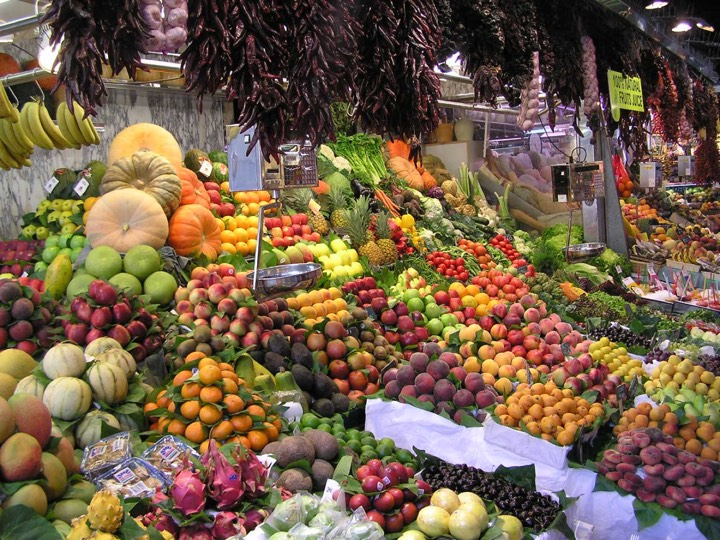
The market is documented from 1217, when butchers set out open-air trestle tables at Pla de la Boqueria beside one of the city gates: farmers from the surrounding villages putting up and taking down their stalls each day. In 1835 the Carmelite convent of Sant Josep that occupied this plot burned down, and on 28 March 1836 the traders moved in. The foundation stone of the permanent market was laid on 19 March 1840, to a design by the architect Josep Mas i Vila. The modernista arch at the Rambla entrance is the work of Antoni de Falguera (1913), and the great iron roof that defines the building today was completed in 1914 — until then every stallholder had to rig up their own awning. A refit between 1998 and 2001 turned it into what it is now, a covered arcaded square rather than an enclosed hall, and a 2015 extension at the back added roughly 1,000 m² (boqueria.barcelona).
The Boqueria restricts large guided visits. Guided groups of more than 15 people cannot enter on Fridays and Saturdays from opening until 15:00; at all other times and on all other days they come and go normally. The measure was adopted at the stallholders' own request, channelled through the Institut Municipal de Mercats de Barcelona, to keep the aisles moving on the busiest days, and market security staff are responsible for turning away groups that don't comply. The practical consequence for you: if you book a food tour, check the group size. The good ones run small groups precisely because of this rule, and they tend to go in early.
What works: a counter. Half a dozen bars inside the market cook to order whatever the neighbouring stalls have that day — baby squid, artichokes, fried eggs with foie, chickpeas with blood sausage, fish off the plancha — and eating it on a stool with the pan thirty centimetres from your face is the best value meal in the old town. Long-standing counters such as El Quim de la Boqueria have a queue from 10:00 and none at all at 8:30. Also worth stopping for: the hand-carved jamón stalls, the salt cod specialists, the nut and dried fruit stalls and the Catalan cheese counters.
What doesn't: the cut-fruit cups and juices at the entrance. This is the market's classic tourist trap. They go for around €5 at the most photogenic stalls in the central aisle, they were cut hours earlier, and the identical cup costs half that three aisles further in. Compare prices before you pay — they're displayed, it takes fifteen seconds. Equally skippable are the paper cones of ham and the trays of pre-cooked "tapas" at the front stalls, designed for people who walk in, take the photo and walk out.
There is no ticket to buy here: La Rambla is a street and the Boqueria is a public market with free access. What you pay for is someone explaining what you're looking at, walking you to the right stalls, or teaching you to cook what you buy. These are the four real options and what each one actually adds.
| Option | Approx. price | Duration | Best for |
|---|---|---|---|
| On your own with this guide | Free | 1.5–2 h | Early risers who want to stop and photograph at their own pace and would rather spend the money on food. |
| Ramblas, Boqueria & Gothic Quarter tour | from ~€25 | ~2–2.5 h | A first visit to Barcelona: it links the boulevard to the medieval core and maps the whole centre in one morning. |
| Street food tour including La Boqueria | from ~€70 | ~3 h | People who came for the food: tastings included, specific stalls, and someone telling you what each thing is. |
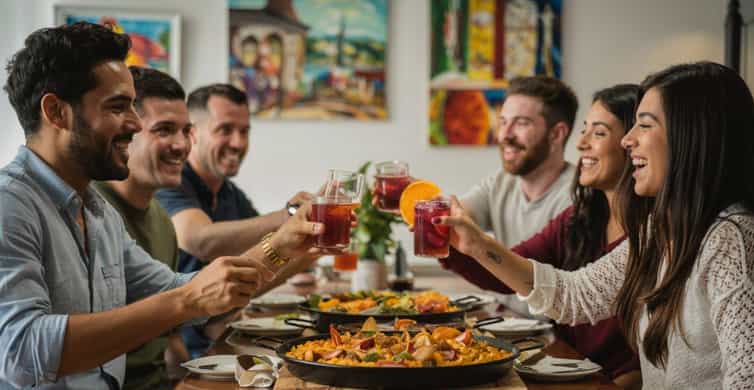
| Cooking class with market tour | from ~€85 | ~4–5 h | Rainy days, longer trips, and anyone who wants to take a paella or a set of tapas home as a skill, not just a memory. |
Indicative prices for third-party activities: they vary by language, group size, season and the tastings included. Check the exact amount in the search box above before booking.
This is worth saying plainly, because nobody does: La Rambla is simultaneously Barcelona's most famous street and the one its residents route around. It isn't snobbery. There are four concrete reasons, and every one of them can be sidestepped.
And you should still walk it, because the market, the Miró mosaic, the Liceu and Plaça Reial are all here and all first-rate. Here's how:
Barcelona is a city with little street violence and a great deal of theft, and La Rambla is its epicentre. Nobody is going to hurt you; they are going to empty your pocket without you noticing. The hotspots and the moments are well known.
What actually works, in order of effectiveness: phone and wallet in a front pocket or a zipped cross-body bag worn in front; nothing valuable in back pockets; bag on your lap, never hanging; a spare card and a copy of your passport left at your accommodation; and automatic suspicion of anyone approaching you with a map, a survey, a "free" bracelet or a drink. Do that and the odds drop to near zero. If it does happen, you can report it at the Mossos d'Esquadra station in Ciutat Vella (Nou de la Rambla, 76), where they deal with several languages; you need the report for your travel insurance even if nothing is recovered.
Beside the Miró mosaic, set into the pavement, there is a discreet piece bearing the date "17.08.2017" and the words "May peace cover you, oh city of peace", reproduced in Catalan, Spanish and English alongside a drawing by the artist Frederic Amat. It remembers the attack on La Rambla of 17 August 2017, in which 16 people were killed and more than a hundred injured. The memorial was installed in 2019, and each anniversary flowers are laid and a minute's silence is held on this exact spot. It sits flush with the ground, with no prominent signage. If you cross it, watch where you step.
Metro. Three L3 (green) stations serve the whole boulevard: Catalunya (also L1) at the northern end, Liceu right at the Boqueria's door, and Drassanes next to the Columbus Monument. No stop is more than five minutes from the next. From the airport, the Aerobús drops you at Plaça de Catalunya, at the head of La Rambla; we cover the options in our Barcelona transport guide.
On foot. The walk is flat from end to end and slopes gently down towards the sea. Plaça de Catalunya to the Columbus Monument is 1.2 km, around 20 minutes without stopping. The hop-on hop-off bus stops at Plaça de Catalunya and at Port Vell — in other words, at both ends.
Accessibility. The whole route is level and the central promenade is smoothly paved, so it works well with a wheelchair or a pushchair. The inside of the Boqueria is accessible too, though the aisles are tight at peak times — another argument for going before 10:00. Two caveats: the refurbishment works shift the accessible routes depending on the section, and the lift in the Columbus Monument is tiny and not adapted. Check station lifts on tmb.cat.
What to combine it with. La Rambla is the hinge of the old town. On your left going down are the Gothic Quarter and Barcelona Cathedral, under five minutes away down any side street. On your right, El Raval, the MACBA and Palau Güell. At the bottom, the harbour and the Aquarium. A well-built day: Boqueria at 8:30, La Rambla down to Plaça Reial, the morning in the Gothic Quarter, lunch one street in, and a Gaudí afternoon in the Eixample.
The word rambla comes from the Arabic ramla, "sandy ground", and it describes precisely what was here: the dry bed of a seasonal stream running down from the Collserola hills to the sea, which only carried water when it rained hard. Through the Middle Ages that channel marked the western edge of the walled city, and convents, hospitals and religious colleges settled along it because the land was cheap and outside the core. That is where the five names come from: the Estudi General of the Rambla dels Estudis, the convents of Sant Josep, of the Capuchins, of Santa Mònica.
The stream was covered over and built up in the second half of the 18th century, and La Rambla became the promenade of the Barcelona bourgeoisie. But the street as you see it is a product of the 19th century: the 1835 disentailment laws and the convent burnings of that same year suddenly freed up all those religious plots, and within a few decades three buildings went up on them — the Boqueria market (1840), the Gran Teatre del Liceu (1847) and Plaça Reial (1848). Food, opera and a public square: the three things that defined the city's cultural axis and, nearly two hundred years later, are still the three reasons to walk down here.
The 20th century added the two remaining layers: modernisme, in Falguera's Boqueria arch of 1913 and in dozens of façades almost nobody looks at; and public art, with Miró's mosaic in 1976, laid just as Barcelona was starting to reclaim its own streets after Franco. Knowing this changes the walk. What looks like a run of souvenir shops is in fact the place where the city twice decided what it wanted to be.
About 20 minutes if you don't stop: it is 1.2 km from Plaça de Catalunya to the Columbus Monument. With real stops — the Boqueria, Palau de la Virreina, the Miró mosaic, the Liceu and Plaça Reial — allow 1.5 to 2 hours. Add a Liceu guided tour or Palau Güell and it becomes half a day.
Before 10:00. The market opens Monday to Saturday from 8:00 to 20:30 and closes on Sundays, according to boqueria.barcelona. Between 8:00 and 10:00 the shoppers are locals and chefs, the side aisles are clear and the counters serve breakfast with no queue. From 11:00 the central aisle is a traffic jam.
Only within limits. Guided groups of more than 15 people cannot enter on Fridays and Saturdays from opening until 15:00; the rest of the week and the rest of the day they enter normally. The rule was introduced at the stallholders' request through the city's markets institute (Institut Municipal de Mercats de Barcelona), and market security enforces it. That is why the better food tours run small groups and start early.
Violent crime, almost none. Pickpocketing, a great deal: La Rambla and metro line L3 account for a large share of the city's thefts. The risk spikes wherever a crowd stops moving — a busker, a living statue, a shell-game table. Phone and wallet in front, backpack on your chest on the metro, and nothing hanging off the back of a café chair.
On the boulevard itself, almost never. The terraces pay extremely high rents and serve customers who will never return, and both facts show up on the plate. The practical rule is to eat one street off it, in the Gothic Quarter or El Raval, or at the counters at the back of the Boqueria. Crossing 50 metres changes everything.
A circular mosaic roughly 8 metres across that Joan Miró set into the pavement at Pla de l'Os, opposite the Boqueria, unveiled in December 1976. Miró asked for no protective coating, so it is walked on like any other paving — which is why thousands of people cross it without noticing. One tile carries the artist's signature.
Yes. There are several visit formats, from a short self-guided route with an audio guide to a 45–50 minute guided tour of the auditorium, the Hall of Mirrors and the Cercle del Liceu private club. Rates sit roughly in the €9–18 range depending on format, and tours run in the morning so they don't clash with rehearsals. Confirm times and prices at liceubarcelona.cat.
Yes. The city council is rebuilding the boulevard in phases: in 2026 work is concentrated on the central promenade and the target is to finish in 2027. You can walk it normally, but expect hoardings, diversions and stretches with fewer terraces. Check the status of the section you care about on barcelona.cat.
Two- to three-hour guided walks and small-group food tours, with free cancellation on most options. And if you came for the food, start with our Barcelona food tours guide.
See dates and prices