Sant Pau Recinte Modernista: tickets and visit
A complex of modernista pavilions set in gardens, a UNESCO World Heritage Site, ten minutes on foot from the Sagrada Família. And almost always empty. Here are the official 2026 prices, the real opening hours, how long you need, and why this is the best-value visit in the Eixample.
ⓘ Note: this is not the official website This is not the official Sant Pau Recinte Modernista website. We are an independent guide: prices and opening hours quoted here come from santpaubarcelona.org, and bookings are processed by authorised partners such as GetYourGuide.Tickets and tours to book
6 options · Prices checked on 18 October 2026
No options match these filters.

Combo: Palau de la Música Catalana + Sant Pau Art Nouveau Site Tickets
4.6 (38 reviews)
from €32Check dates
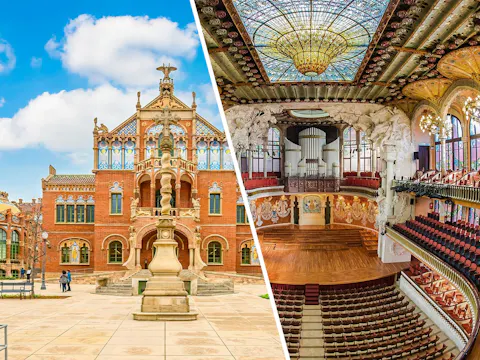
Combo: Recinte Modernista Sant Pau + Palau de la Música Catalana Tickets
3.0 (2 reviews)
from €32Check dates
The essentials in 20 seconds
| Price from | €18 self-guided before 2pm · €17 from 2pm · free for accompanied under-12s |
|---|---|
| Opening hours | April–October 9:30–18:30 · November–March 9:30–17:00 · last admission 30 min before closing · closed 25 December |
| Advance booking? | Not essential — it rarely sells out. Worth it for guided tours, which have fixed times by language |
| Time needed | 1 hr 30 min – 2 hrs self-guided · ~1 hr on the guided tour |
| Metro | Sant Pau | Dos de Maig (L5 blue), 5 minutes · Guinardó | Hospital de Sant Pau (L4 yellow), 5 minutes downhill |
| Key fact | UNESCO World Heritage since 1997, inscribed in the same listing as the same architect's Palau de la Música Catalana |
Tickets: the price changes at two o'clock
Sant Pau does something almost no other Barcelona monument does: the self-guided ticket costs a different amount depending on what time you walk in. Before 2pm it is €18; from 2pm it is €17. One euro is not going to change your holiday, but it does point at something useful — the afternoon is the quieter shift, and the site is better for it.
| Ticket | Price | What it covers | Best for |
|---|---|---|---|
| Self-guided (before 2pm) | €18 · €12.60 reduced | Gardens, the pavilions open to visitors and a section of underground gallery, with map and panels | Most people. The site reads clearly without a guide. |
| Self-guided (from 2pm) | €17 · €11.90 reduced | Exactly the same route, one euro cheaper | Late starters, and anyone who wants warm afternoon light. |
| Guided tour | €21 · €14.70 reduced · €5 ages 3–11 | About an hour with a professional guide through the main pavilions | Anyone who wants the medical and urban logic, not just the tilework. |
| Audio guide | +€4 on top of entry | Narrated route at your own pace | Context without being tied to a group's timetable. |
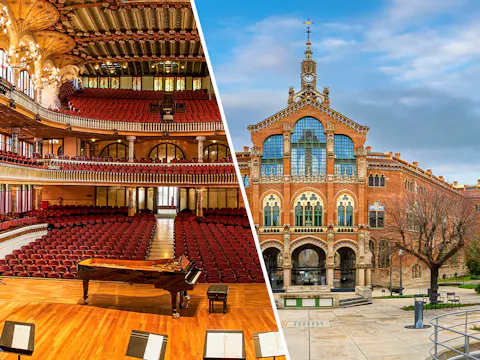
| Palau + Sant Pau combined | €32 (per palaumusica.cat) | Both Domènech i Montaner buildings covered by the same UNESCO inscription | Seeing the modernisme that isn't Gaudí. |
Official rates per santpaubarcelona.org (August 2026). The reduced rate applies to Barcelona residents, visitors aged 12–24, over-65s and people with a disability below 65%. Free admission for accompanied children under 12, visitors with a disability of 65% or more, unemployed people with Spanish documentation and ICOMOS members; over-65s go free on the first Sunday of the month in organised groups. The €32 Palau + Sant Pau combined price comes from palaumusica.cat. Third-party products vary in price by date, language and availability.
What you actually see: a small city turned 45 degrees
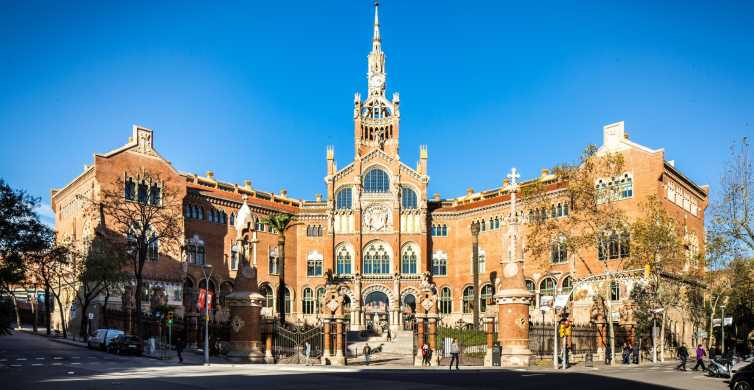
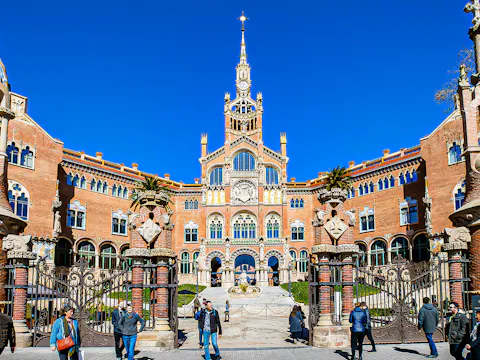
From the street it looks like one red-brick façade with a clock tower and a great deal of sculpture on it. Then you go through the door, climb to the viewing terrace and realise that the building was never the point — it was the gatehouse of an entire town: freestanding pavilions, gravel avenues, orange trees, cypresses, and an unexpected skyline with the towers of the Sagrada Família rising at the end of the axis. These are the parts not to skip:
- The Administration Pavilion. The entrance building: symmetrical, clock tower on top, and a vaulted lobby of ceramic and mosaic telling the hospital's story back to 1401. It is the most decorated point of the whole complex and where the sculpture is concentrated — work by Eusebi Arnau and his pupil Pau Gargallo, with the angels by Arnau and the lions by Gargallo.
- The Sant Salvador pavilion. The restored ward pavilion that best shows what a modernista hospital room was like: very high ceilings, tiling to half height (easy to wash down, with no corners for dust to gather in), enormous windows and rounded junctions everywhere instead of right angles. The decoration was not decoration. It was hygiene.
- The underground galleries. More than a kilometre of tunnels connected every pavilion so that stretchers, meals, laundry and staff could move below ground — keeping patients out of the cold and clean routes from crossing dirty ones. One lit, brick-vaulted stretch is open to visitors.
- The gardens. They take up most of the site, and they are not landscaping — they are the argument of the building. You can walk slowly, sit down and take photographs here without anyone shoving past you, which on the rest of Barcelona's modernista circuit simply does not happen.
- The orientation. The entire complex is rotated 45 degrees against Cerdà's Eixample grid. That is not an aesthetic whim: turned this way, every pavilion catches sun at some point in the day and air currents run through the whole site. Look at the map as you come in — it is the strangest and the cleverest thing about the place.
When to go: the empty monument of the Eixample
Worth saying plainly, because it is the main reason to come: Sant Pau gets a fraction of the visitors the Sagrada Família does, ten minutes away on foot. There is no fifteen-minute timed-entry system, no queue snaking along the pavement, no tour groups treading on each other. It is a World Heritage Site you walk around like a neighbourhood park.
- First thing (9:30–11:00). Effectively alone. Morning light rakes across the Administration façade and that is when it photographs best.
- 12:00 to 14:00 is the peak — although "peak" here means people spread across the gardens, not congestion. If you arrive with an organised group from the Sagrada Família, this is the slot you will get.
- From 2pm the price drops to €17, the site empties again and the sun hits the brick and glazed ceramic head-on, which is when the colour really works. In summer, with an 18:30 closing, that leaves you a comfortable four hours.
- Watch the clock in winter: November to March it closes at 17:00, so last admission is 16:30. It gets dark early, and the gardens lose a lot without light.
- Quietest days: midweek. Weekends and public holidays bring scheduled guided tours, a few more local visitors, and the occasional event or concert in the pavilions.
How to pay less
- Go in after 2pm: identical route, €17 instead of €18. It is the easiest discount in the Eixample.
- Reduced rate (€12.60 / €11.90): Barcelona residents, visitors aged 12–24, over-65s and people with a disability below 65%, according to the official site. Bring proof.
- Under-12s go free when accompanied by an adult. On the guided tour, children aged 3–11 pay €5.
- Three free days a year: 23 April (Sant Jordi), the Nit dels Museus and 24 September (La Mercè). No guided tours run on those dates and the site genuinely fills up — the only occasion when the word "queue" applies here.
- Combined with the Palau de la Música for €32 per palaumusica.cat: cheaper than buying both separately, and the logical pairing, since they share an architect and a UNESCO inscription. A combined ticket with La Pedrera also exists.
- Check whether a city pass pays off before buying single tickets — we break them down in the city passes guide.
- Completely free, you can see the Administration façade from Avinguda de Gaudí and the edge of the gardens through the railings. It is an excellent photograph, but the pavilions and the tunnels are inside.
Getting there and what to combine it with
Address: Carrer de Sant Antoni Maria Claret, 167, 08025 Barcelona, on the corner of Carrer de Cartagena, where the Eixample meets the Guinardó district.
Metro: Sant Pau | Dos de Maig (L5 blue) leaves you about five minutes' walk away. Guinardó | Hospital de Sant Pau (L4 yellow) is just as close and often easier if you are coming from the Gothic Quarter or Passeig de Gràcia; from there it is a short downhill walk. Bus lines H8, 19, 47, 117 and 192 also stop nearby.
Walking from the Sagrada Família: this is the way to arrive. Ten minutes along Avinguda de Gaudí, a pedestrianised diagonal avenue with Pere Falqués lamp posts, café terraces, benches and shade, running literally between the two buildings. It was laid out that way on purpose: the axis connects Gaudí's basilica to Domènech i Montaner's hospital and ends head-on at the Administration façade, which appears in front of you at the end of the street. If you are coming from the Sagrada Família, do not take the metro — it would be the worst trade of the trip.
Accessibility: the site is large — reckon on fifteen minutes to walk from one end to the other — but mostly flat, with ramps and lifts in the pavilions open to visitors and a lift down to the underground gallery. There are cobbled stretches and some gentle changes of level between gardens. For a specific adapted route, ask at reception on the way in.
Practicalities: there are toilets, a shop and a café. Carry water in summer, because much of the route is outdoors and the gardens give less shade than they look like they will. Comfortable shoes: there is real walking here.
What to pair it with
The obvious combination is Sagrada Família early, Sant Pau afterwards, with Avinguda de Gaudí in between and lunch on one of its terraces. If you would rather follow the architect than the neighbourhood, the other end of the thread is the Palau de la Música Catalana in the old town. And if what you want is residential modernisme — Casa Batlló, La Pedrera, Casa Amatller — it is all on Passeig de Gràcia, sorted out in our modernista houses guide.
A minute of context (it changes what you're looking at)
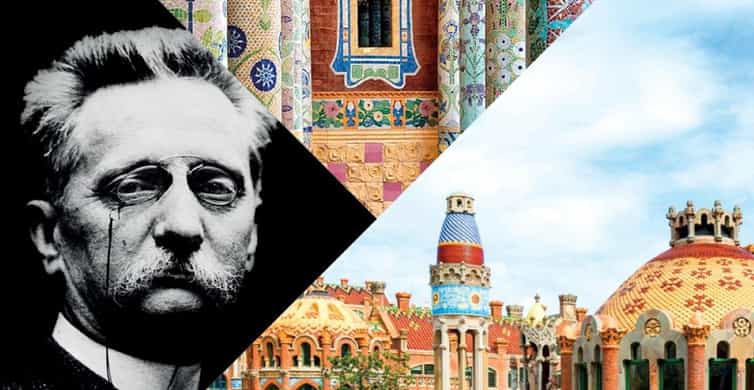
In 1401, six medieval hospitals in Barcelona merged into one, the Santa Creu, in the Raval. Five hundred years later that building was too small and too unhealthy, and a bequest from the banker Pau Gil paid for a new one. The commission went to Lluís Domènech i Montaner and work started in 1902. He died in 1923; his son, Pere Domènech i Roura, finished the complex in 1930. It ran as a working hospital until 2009, when medical activity moved to a new building just north of the site. Restored, it opened to the public in 2014 as the Recinte Modernista.
What makes it exceptional is not the ceramic — it is the idea. In the early twentieth century the standard hospital was a barrack block: long floors, wards in a row, cheap to build and extremely good at spreading infection. Domènech i Montaner, who studied more than two hundred European hospitals before he drew anything, did the opposite. He broke the building into separate pavilions surrounded by garden, connected them below ground with more than a kilometre of galleries so that clean and dirty routes never crossed, and rotated the whole complex 45 degrees against the Eixample grid so that sunlight reached all of them. Behind it was a conviction that sounds contemporary now and was close to a political statement then: that light, air and beauty are part of the treatment. The mosaics, the high ceilings and the rounded corners were not luxury. They were clinical protocol.
The scheme was more ambitious still than what stands today: the early planning envisaged nearly fifty pavilions, and published counts of what was actually built vary by source — you will see 27 buildings quoted for the complex and something over a dozen properly modernista pavilions, six of them fully restored for the 2014 opening. Whatever the exact tally, the scale registers the moment you walk in.
UNESCO added the Hospital de Sant Pau to the World Heritage list in 1997, in the same inscription as the Palau de la Música Catalana. Which means Barcelona's two listed Domènech i Montaner buildings share a single certificate — and the city treats them completely differently. At the Palau, time slots sell out. Here, on a site twenty times the size, you can sit on a bench looking at one pavilion for half an hour and nobody will walk past. If you arrive saturated with Gaudí after the Sagrada Família and Casa Batlló, Sant Pau is the antidote: the other modernisme, the one built from straight lines, brick and applied mosaic, and the one that asked what a building was for before it asked what it should look like.
Frequently asked questions
How much does a ticket to Sant Pau Recinte Modernista cost in 2026?
According to the official website (santpaubarcelona.org), the self-guided visit costs €18 before 2pm and €17 from 2pm onwards. The reduced rate is €12.60 and €11.90 respectively, and the guided tour is €21 (€14.70 reduced). The audio guide is €4 extra. Accompanied children under 12 go free.
What are the opening hours of Sant Pau Recinte Modernista?
April to October, daily 9:30–18:30; November to March, 9:30–17:00, per santpaubarcelona.org. Last admission is 30 minutes before closing and the site closes on 25 December. Some third-party listings still show shorter Sunday hours, so check the official site the day before you go.
Can you walk to Sant Pau from the Sagrada Família?
Yes, and it is the best way to arrive: ten minutes along Avinguda de Gaudí, a pedestrianised diagonal avenue with terraces and benches linking the two buildings. At Carrer de Sant Antoni Maria Claret the Administration Pavilion and its clock tower are straight ahead. We flag the same walk in our Sagrada Família guide.
How long do you need at Sant Pau?
An hour and a half to two hours self-guided, allowing for the gardens, the open pavilions and the stretch of underground gallery. The guided tour runs about an hour and most people continue on their own afterwards. For just the Administration Pavilion and the gardens, a good hour will do.
Do I need to book tickets in advance?
Not the way you do at the Sagrada Família or Park Güell. Sant Pau rarely sells out and there is almost always same-day availability. Booking online saves the ticket-office queue and secures a place on the guided tours, which do have limited capacity and fixed times by language.
Is the guided tour worth it, or is self-guided enough?
Self-guided works well — the site explains itself with a map and panels. The guided tour (€21, about €4 more than a morning self-guided ticket) adds what you cannot see: how the hospital worked, why the complex was rotated 45 degrees, what the tunnels were for. Spanish and Catalan departures run at weekends and on holidays, English and French on Saturdays.
Is Sant Pau wheelchair accessible?
Broadly yes: large but mostly flat, with ramps and lifts in the pavilions open to visitors and a lift down to the gallery. There are cobbled stretches and some gentle level changes between gardens. For a specific adapted route, ask at reception when you arrive.
Are there free admission days at Sant Pau?
Yes: 23 April (Sant Jordi), the Nit dels Museus and 24 September (La Mercè), according to the official website. No guided tours run on those days. Accompanied children under 12 and visitors with a disability of 65% or more also enter free year-round.
Book your Sant Pau Recinte Modernista ticket
You don't need to book weeks ahead here, but buying online skips the ticket office and secures a spot on the guided tours. And if you're seeing both Domènech i Montaner buildings, the combined ticket with the Palau de la Música works out cheaper.
See dates and prices