Montjuïc Barcelona: what to see, the castle and how to get up the hill
Montjuïc is not an attraction. It is a 173-metre hill with two world's fairs built on top of it, half a dozen museums, an Olympic stadium, a military castle, a monumental cemetery and the best gardens in Barcelona. Almost nobody uses it properly, because they arrive at the top, see one thing and leave. Here is the whole hill — price, time needed and whether it is worth it, site by site — the four ways up, and a route that works through it from the bottom in a single day.
ⓘ Note: this is not the official website This is not the official website of Montjuïc Castle, the MNAC, the Fundació Joan Miró, Poble Espanyol, the Fundació Mies van der Rohe or Barcelona City Council. We are an independent guide: the figures quoted come from their official websites, and bookings are processed by authorised partners such as GetYourGuide.Tickets and tours to book
24 options · Prices checked on 18 October 2026
No options match these filters.
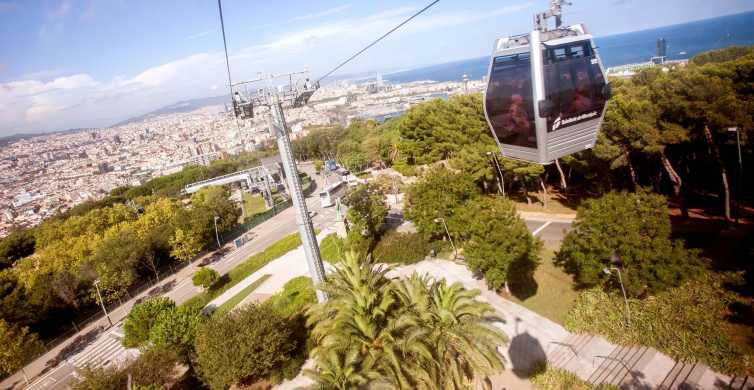
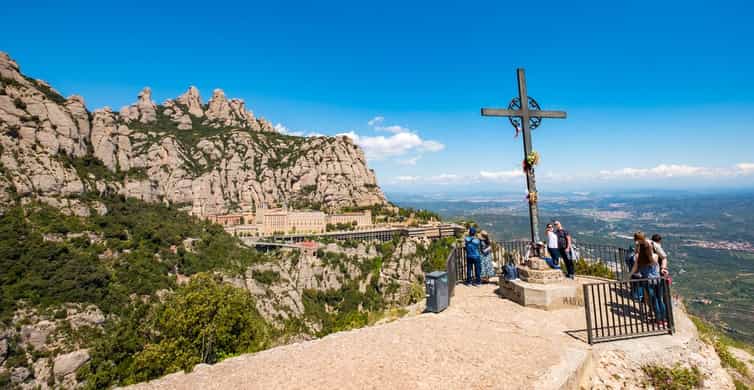
From Barcelona: Montserrat Monastery, Easy Hike, Cable Car
4.9 (1,335 reviews)
from €69.56Check dates

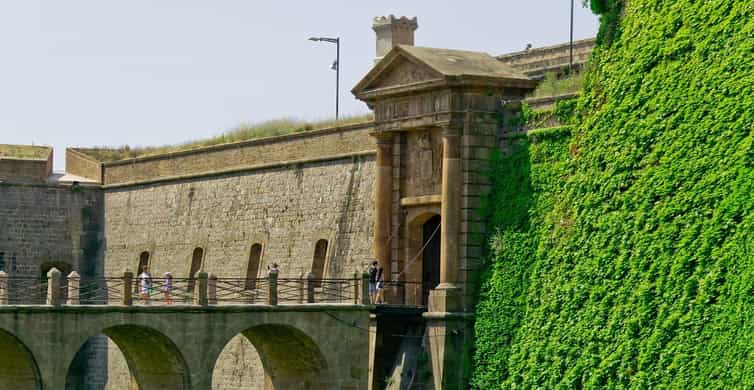



Barcelona: E-Bike, Montjuic Cable Car,and Sailing Experience
5.0 (18 reviews)
from €80.10Check dates

The essentials in 20 seconds
| Price from | €0 if you stick to gardens, viewpoints and exteriors · €2 for the MNAC basic ticket with roof terraces · €12 for the castle |
|---|---|
| Reference hours | Castle and Mies Pavilion 10:00-20:00 March to October, 10:00-18:00 November to February · gardens dawn to dusk |
| Do you need to book? | Not for the gardens. The castle sells tickets online only, so buy yours before going up; for the MNAC, Miró and Poble Espanyol, book online in summer and on long weekends |
| Visit duration | Half a day minimum · a full day if you go inside two museums and the castle |
| Metro | Espanya (L1/L3) for the lower half · Paral·lel (L2/L3) plus the funicular for the upper half |
| The fact that changes your plan | The MNAC, Fundació Miró and CaixaForum close on Mondays. The castle, the gardens and Poble Espanyol open daily |
What to see on Montjuïc: price, time and whether it is worth it
| Site | Ticket | Time | Worth it? |
|---|---|---|---|
| Montjuïc Castle | €12 general · €8 reduced · free Sun from 15:00 | 1-1.5 h | Yes. A 360° view over the port and a hard history told without varnish |
| MNAC | €12 general (valid 2 days) · €2 basic building and terraces ticket | 2-3 h | Yes, emphatically. The Romanesque collection does not exist anywhere else |
| Fundació Joan Miró | €17 online · €18 at the desk · €11 reduced | 1.5-2 h | Yes if you care about Miró or about Sert's architecture. Otherwise skip it |
| Poble Espanyol | €14.40 online · €16 at the gate · €9/€10 children 4-12 | 2-3 h | With children or an interest in crafts, yes. As "Spain in a day", with caveats |
| Mies van der Rohe Pavilion | €9 general · €5 reduced · free 1st Sunday | 30-40 min | Yes if you look at buildings. It is small: don't expect a museum |
| CaixaForum | €6 general | 1-1.5 h | Yes. Puig i Cadafalch's factory is worth the ticket on its own |
| Olympic Ring (outside) | Free · Olympic Museum €6.30 | 45 min-1 h | As a walk, yes. The stadium is usually viewed from outside only |
| Botanical Garden | €3.50 · free Sun from 15:00 | 1-1.5 h | Yes in spring and autumn. In August, go early or not at all |
| Jardins de Costa i Llobera | Free | 30-45 min | Yes. Giant cacti above the sea and hardly anyone there. The hill's best surprise |
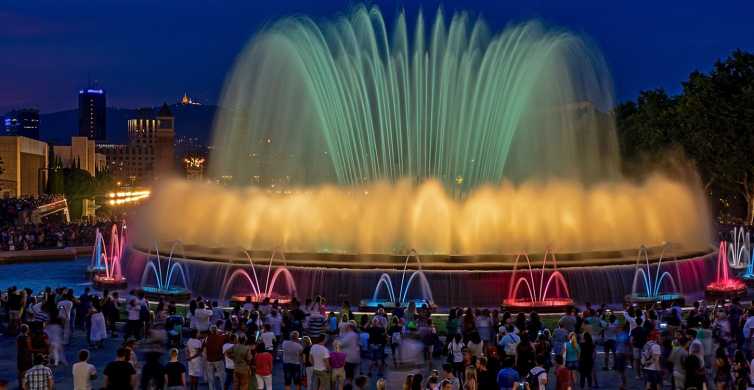
| Magic Fountain | Free | 30 min | Yes, if your dates fall in show season. Check the day before you commit an evening |
Prices and hours per ajuntament.barcelona.cat/castelldemontjuic, museunacional.cat, fmirobcn.org, poble-espanyol.com, miesbcn.com, caixaforum.org, museuciencies.cat and museuolimpicbcn.cat, checked in August 2026. They change without notice — confirm before you buy.
One by one: what you will actually see
Montjuïc Castle
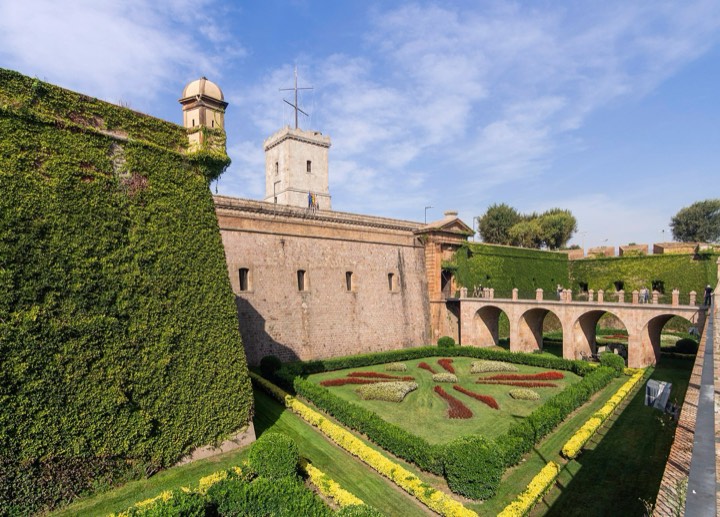
The fortress standing today dates from 1751-1779, the work of military engineer Juan Martín Cermeño on top of an earlier 1640 fort. You walk the moat, the bastions and the upper rampart, which looks out over the container port, the Llobregat delta and the whole city. Inside, a permanent exhibition tells the story straight: the guns here shelled Barcelona in 1842, and President Lluís Companys was executed in the moat on 15 October 1940. The city council only regained the site in 2007. Ticket: €12 general and €8 reduced per ajuntament.barcelona.cat, free for under-16s, every Sunday from 15:00 and all day on the first Sunday of the month. Time: an unhurried hour and a half. Verdict: essential, more for what it tells you than for what it displays.
MNAC, inside the Palau Nacional
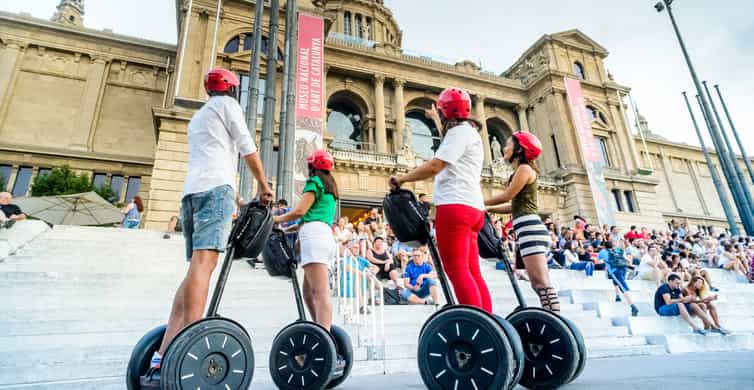
The 1929 Exposition palace holds the world's finest collection of Romanesque mural painting: entire apses stripped from Pyrenean churches between 1919 and 1923 to stop them being sold to foreign collectors, with the Christ Pantocrator of Sant Climent de Taüll as the centrepiece. Upstairs there is Gothic, Renaissance, Modernisme and a Gaudí room. The trick: per museunacional.cat, the basic ticket of €2 covers the building and the roof terraces; the €12 general ticket includes the collection and the terraces and is valid for two days within a month. Time: a good two hours for the Romanesque alone. Closed Mondays. More context in our guide to Barcelona museums.
Fundació Joan Miró
Miró set the foundation up in his own lifetime and commissioned the building from his friend Josep Lluís Sert, who finished it in 1975: white vaults, curved skylights and courtyards that pull Mediterranean light into the galleries. You get paintings, sculptures, tapestries and Alexander Calder's Mercury Fountain, rescued from the 1937 Paris Exposition. Ticket: €17 online and €18 at the desk, €11 reduced and free for under-12s, per fmirobcn.org. Time: an hour and a half. Verdict: one of the few museums where the container explains the contents.
Poble Espanyol
117 buildings reproducing streets, squares and monuments from across Spain, put up in 1929 after a research trip round the peninsula. It works as a real village today: craft workshops you can walk into — glassblowing, leather, jewellery — the Fran Daurel museum, restaurants and a concert venue. Ticket: per poble-espanyol.com, €14.40 booked in advance online and €16 at the gate; €9/€10 for children aged 4-12 and free under 4. Time: two and a half hours. Verdict: with children or an interest in craft, it works very well; if you want authentic monuments, know what you are buying. You can book the skip-the-line ticket or the combined ticket with a Montjuïc audio tour.
Mies van der Rohe Pavilion
The 1929 German Pavilion, by Ludwig Mies van der Rohe and Lilly Reich, was dismantled in 1930 and existed only in photographs for fifty years; between 1983 and 1986 it was rebuilt on its original plot by Ignasi de Solà-Morales, Cristian Cirici and Fernando Ramos. It is a travertine platform with planes of onyx, green marble and glass, a pool holding Georg Kolbe's Alba, and at its centre the Barcelona Chair, designed by Mies and Reich so that King Alfonso XIII could preside over the opening. Ticket: €9 general and €5 reduced, free for under-16s and on the first Sunday of the month, per miesbcn.com. Time: half an hour. Book the ticket with audio guide if you want to understand what you are looking at.
CaixaForum and the Casaramona factory
The former Casaramona textile mill, completed in 1911 by Josep Puig i Cadafalch, is industrial Modernisme in bare brick: open-plan halls, water towers and not a single chimney, because the power was electric. It spent decades as a mounted-police barracks and reopened as a cultural centre in 2002, programming large temporary exhibitions. Ticket: €6 general per caixaforum.org, open daily 10:00-20:00.
The Olympic Ring
The Estadi Olímpic Lluís Companys was built for the 1929 Exposition to a design by Pere Domènech i Roura, then gutted and rebuilt inside for 1992 while keeping the original façade. Beside it stands Arata Isozaki's Palau Sant Jordi (1990), whose roof was assembled at ground level and jacked into place, and Santiago Calatrava's white communications tower, tilted at 19.5° and conceived as a sundial casting its shadow across Plaça d'Europa. The Bernat Picornell pools and the Joan Antoni Samaranch Olympic and Sports Museum (€6.30 general, €3.90 students) complete the set. Verdict: the walk round the outside is free and gives you the full measure of what 1992 meant here.
Gardens: Costa i Llobera, the Botanical and the rest
Montjuïc has more garden than museum. The Jardins de Costa i Llobera, on the seaward slope, hold one of Europe's largest collections of cacti and succulents, several metres tall against the backdrop of the port: free, and almost always empty. The Jardí Botànic, next to the stadium, arranges the flora of the world's five Mediterranean climate zones by continent; it costs €3.50 and is free on Sundays from 15:00 and all day on the first Sunday of the month. On the northern slope you have the Jardins de Laribal with the Font del Gat, the Mossèn Cinto Verdaguer gardens (bulbs and water lilies, at their best in March and April) and the Joan Brossa gardens, all free. If that is your thing, see our guide to squares and parks.
Magic Fountain and cemetery
At the foot of the staircase, Carles Buïgas's Magic Fountain has been running since 1929 and puts on a free water, light and music show in season, on a calendar that shifts and with cancellations for wind or drought: check days and times on our Magic Fountain page before you build an evening around it. And on the southern slope, Montjuïc Cemetery (1883) is an open-air museum of Modernista mausoleums holding Europe's only collection of funeral carriages; entry is free from 8:00 to 18:00, with QR codes explaining the monuments in four languages.
How to get up Montjuïc: the four ways
| Option | From | Price | Drops you at |
|---|---|---|---|
| Outdoor escalators | Metro Espanya (L1/L3) | Free | The MNAC and, further on, Poble Espanyol and the Olympic Ring |
| Montjuïc funicular | Metro Paral·lel (L2/L3) | One T-casual journey · included in Hola BCN | Avinguda Miramar, halfway up, next to the Fundació Miró |
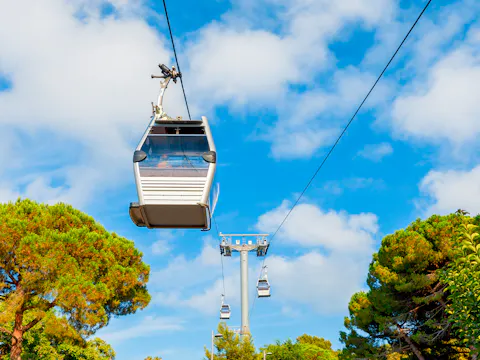
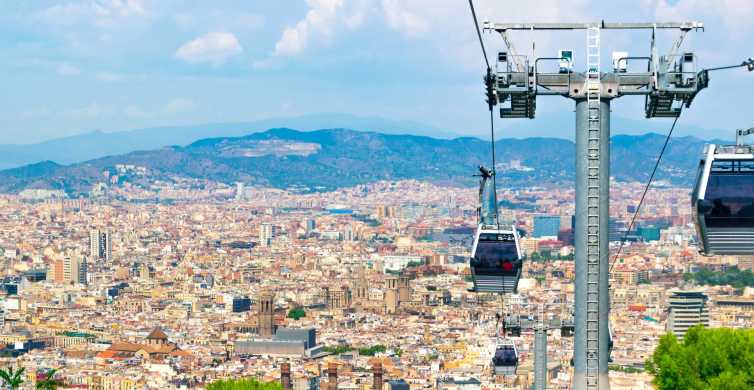
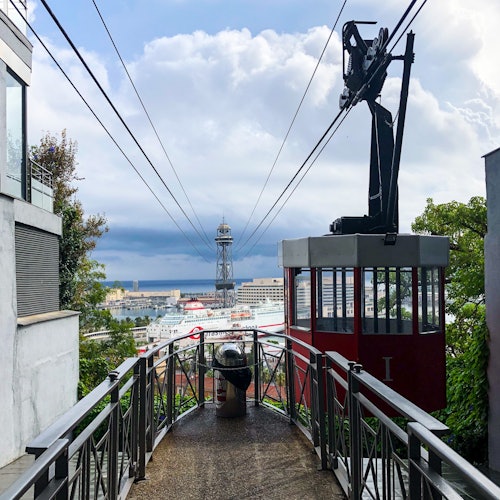
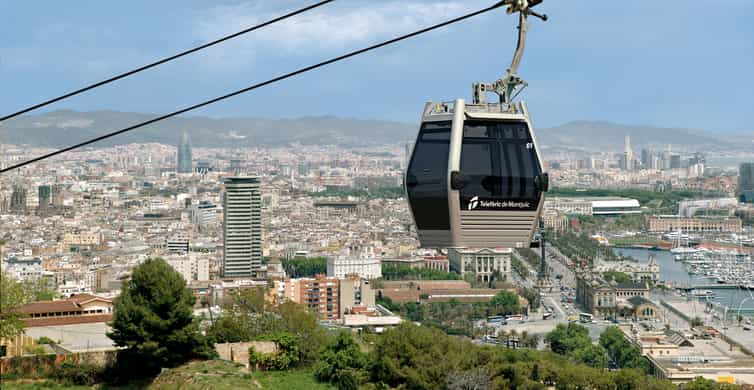
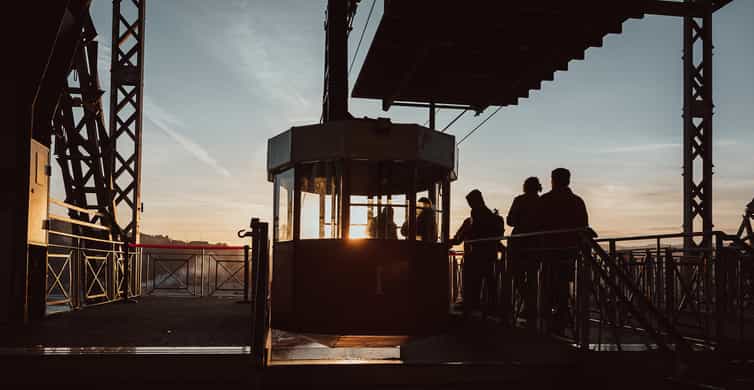
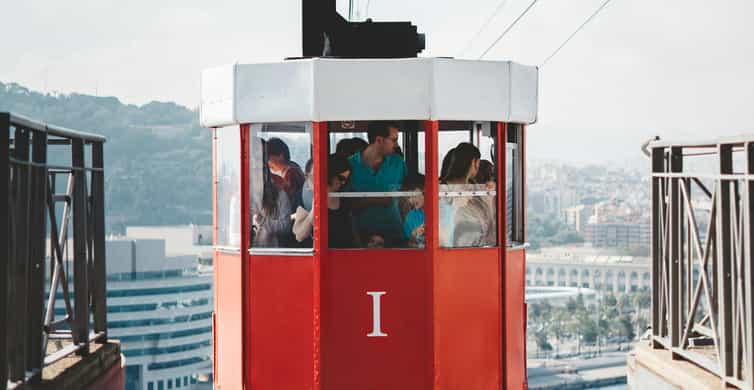
| Montjuïc cable car | Funicular exit | ~€16 return adult · ~€11.60 children 4-12 | Montjuïc Castle (non-stop up; the Mirador del Alcalde stop is on the way down) |
| Bus 150 | Plaça d'Espanya | Standard TMB fare | Climbs the whole hill as far as the castle |
| Bus 55 | Plaça de Catalunya via Paral·lel | Standard TMB fare | Plaça Dante, beside the funicular and cable car |
| Hop-on hop-off bus | Plaça de Catalunya | Per your pass | Several stops on the hill: Magic Fountain, Miró, Olympic Ring |
The bit most people miss: the Montjuïc funicular is not a tourist ride, it is part of the metro network. It leaves from inside Paral·lel station (L2 and L3) — you never go out to the street — and is covered by the T-casual and the Hola Barcelona Travel Card, so if you already hold a travel ticket the climb costs you nothing extra. It takes about two minutes. From its upper exit on Avinguda Miramar, the Fundació Miró is five minutes on foot and the Montjuïc cable car station a couple.
The outdoor escalators from Plaça d'Espanya are the other free option, and the more scenic one: they climb in flights along Avinguda de la Reina Maria Cristina, past the Venetian towers and the Magic Fountain, and then up the Palau Nacional staircase to the MNAC terraces. From there they keep going towards Poble Espanyol and the Olympic Ring. Free, partly covered, and they take out all the serious gradient.
The hop-on hop-off bus routes also cross the hill, stopping at the Magic Fountain, Poble Espanyol, the Fundació Miró and the Olympic Ring. It is the comfortable option if you are short on time and want to see everything from above without walking, though frequencies stretch out in high summer. Ticket types and transport combinations are covered in our Barcelona transport guide.
A one-day route from the bottom up (and the half-day version)
A full day, from Plaça d'Espanya to the castle
- 9:30 · Plaça d'Espanya. Start at the bottom, with Ramon Reventós's Venetian towers framing the avenue. Ten minutes.
- 9:45 · CaixaForum. Cross to the left: the Casaramona factory opens at 10:00 and is empty at that hour. One hour.
- 11:00 · Mies van der Rohe Pavilion. Literally opposite. A long half-hour, and don't leave without walking round the rear pool.
- 11:45 · MNAC. Take the escalators up. Romanesque first, roof terraces afterwards with the city in front of you. Two and a half hours.
- 14:15 · Lunch. The MNAC's own café-restaurant under the dome, or walk down into Poble-sec in twenty minutes for neighbourhood prices.
- 15:30 · Fundació Miró or Poble Espanyol, depending on the group. With children, Poble Espanyol without hesitating. Two hours.
- 17:30 · Cable car to the castle. From Avinguda Miramar. A few non-stop minutes with the harbour underneath you.
- 18:00 · Montjuïc Castle. Rampart walk, exhibition and the last good light on the sea. An hour and a half.
- 19:45 · Walk down through the Miramar and Laribal gardens, or take the cable car back if your legs have had enough. If it is Magic Fountain season, finish with the show at the bottom.
Half a day: four hours well spent
Pick one block rather than half of each. Upper block (transport and views): metro to Paral·lel, funicular, cable car, castle, then walk down through the Laribal gardens into Poble-sec. Four hours flat, with almost all the spending on the cable car. Lower block (1929): metro to Espanya, CaixaForum, the Mies Pavilion, the MNAC with its terraces and, if there is room, Poble Espanyol. Same time, no hills at all thanks to the escalators.
On a tight budget: funicular on your T-casual, Jardins de Costa i Llobera, the Mirador de l'Alcalde, the €2 basic MNAC ticket for the terraces, and walk down through the gardens. A full day on the hill for the price of two metro rides and a coffee. Other panoramas compared in our guide to Barcelona viewpoints.
How to save: free days, discounts and passes
- Sunday afternoons. Montjuïc Castle and the Jardí Botànic are free every Sunday from 15:00, and free all day on the first Sunday of the month. The Mies Pavilion is also free on the first Sunday of the month.
- Saturday afternoons at the MNAC. The museum opens free on Saturdays from 15:00 and on the first Sunday of the month. Book the slot the moment it is released — it goes.
- Young and old. The castle is free for under-16s; the MNAC charges nothing to under-16s or over-65s; the Fundació Miró is free under 12 and €11 for ages 13-25 and over-65s; the Mies Pavilion is free up to 16.
- Online is cheaper. At Poble Espanyol the gap between booking ahead and paying at the gate is €1.60 per adult; at the Fundació Miró it is €1. The castle sells tickets online only, so buy before you go up.
- Passes. The Articket covers the MNAC and the Fundació Miró alongside four other art museums and pays off from the third one. The Barcelona Card bundles museums with unlimited public transport, funicular included. Compare both in our guide to city passes, and see the full catalogue on all tickets.
- What costs nothing. Gardens, viewpoints, the exterior of the Olympic Ring, the cemetery and the Magic Fountain. You can spend a whole day on Montjuïc without buying a single ticket.
The name, 1929 and 1992: why the hill looks like this
Where "Montjuïc" comes from. There are two explanations and it is worth knowing both. The first derives it from the Latin Mons Iovis, "mount of Jupiter", assuming a Roman temple on the summit that has never been located. The second reads it as "mount of the Jews", after the medieval Jewish cemetery documented on the slope from the 11th century, from which more than seven hundred graves and headstones with Hebrew inscriptions have been recovered. The medieval forms of the name — Montjuich, Mont dels jueus — point mainly to the second, which is now the majority reading among historians, though the first still turns up in guidebooks. Neither is proved beyond doubt: anyone selling you one as settled is selling you something.
1929: the hill invented in two years. Montjuïc was quarry, allotments and shacks until the 1929 International Exposition urbanised the whole of it. That operation produced the Palau Nacional (Eugenio Cendoya, Enric Catà and Pere Domènech i Roura), Poble Espanyol — conceived by Josep Puig i Cadafalch and carried out by Francesc Folguera, Ramon Reventós, Xavier Nogués and Miquel Utrillo — Carles Buïgas's Magic Fountain, the Venetian towers, the stadium, and the terraced garden system of Jean-Claude Nicolas Forestier and Nicolau Maria Rubió i Tudurí. And the German Pavilion by Mies van der Rohe, which stood for eight months, was demolished in 1930, and became — in photographs alone — one of the most influential buildings of the 20th century long before anyone thought of rebuilding it.
1992: the hill reinvented. Sixty years later, the Olympic Games put the focus back up here. The 1929 stadium was kept on the outside and rebuilt within; Arata Isozaki raised the Palau Sant Jordi; Calatrava planted his white tower; and the city used the moment to open up its seafront and build its ring roads. What you walk through today is really three layers stacked on each other: a military fortress that pointed its guns at the city, a world's fair that wanted to show the city off, and a Games that rebuilt it. Montjuïc is far better once you see that — every building belongs to a different idea of what Barcelona was supposed to be.
Frequently asked questions
How long do you need for Montjuïc?
A full day if you want to go inside two museums and the castle: about eight hours including travel and lunch. In half a day (four hours) you can ride the funicular and cable car, see the castle and walk down through the gardens, or do the 1929 block at the bottom: CaixaForum, the Mies Pavilion and the MNAC. What does not work is trying to do all of it in one morning.
How do you get up to Montjuïc?
Four ways. Metro Espanya (L1/L3) and the free outdoor escalators that climb past the MNAC staircase. Metro Paral·lel (L2/L3) and the Montjuïc funicular, which is part of the metro network and is covered by the T-casual and the Hola Barcelona Travel Card. The Montjuïc cable car from the funicular exit up to the castle, ~€16 return. And buses 150 (Espanya to the castle) and 55 (as far as Plaça Dante). The hop-on hop-off bus also stops several times on the hill.
How much is Montjuïc Castle and when is it free?
According to ajuntament.barcelona.cat, general admission is €12 and the reduced rate €8. Entry is free for under-16s, every Sunday from 15:00 and all day on the first Sunday of the month. Opening hours are 10:00-20:00 from March to October and 10:00-18:00 from November to February.
Is the MNAC worth it just for the view?
Yes, and there is a little-known trick: according to museunacional.cat there is a €2 basic ticket that covers the building and the roof terraces without the collection. The €12 general ticket includes both and is valid for two days within a month. If you are coming for the Romanesque murals you need the general ticket and a good two hours.
Can you visit Montjuïc for free?
Almost all of it. The gardens (Costa i Llobera, Laribal, Mossèn Cinto Verdaguer, Joan Brossa), the outside of the Olympic Ring, the cemetery, the Magic Fountain and every viewpoint cost nothing. The castle is free on Sundays from 15:00, so is the Botanical Garden, and the MNAC opens free on Saturdays from 15:00 and on the first Sunday of the month.
What does the name Montjuïc mean?
There are two theories and neither is settled. The first derives it from the Latin Mons Iovis, mount of Jupiter, assuming a Roman temple on the summit. The second, now more widely accepted among historians, reads it as mount of the Jews, after the medieval Jewish cemetery documented on the slope from the 11th century, from which headstones with Hebrew inscriptions have been recovered. The medieval forms of the place name point mainly to the second.
What survives from the 1929 International Exposition?
Far more than people assume. The Palau Nacional (now the MNAC), Poble Espanyol, Carles Buïgas's Magic Fountain, the Venetian towers on Plaça d'Espanya, the stadium, and the avenues and terraced gardens on the slope. Mies van der Rohe's German Pavilion was demolished in 1930 and rebuilt on the same plot between 1983 and 1986.
Cable car or funicular: which is better?
They are different things and they work together. The funicular is public transport: it leaves from inside Paral·lel metro station, costs one T-casual journey and drops you halfway up the hill in two minutes. The cable car is an attraction: eight-seat gondolas, ~€16 return and a few minutes of harbour views up to the castle. The efficient move is funicular to get up and cable car only for the final stretch.
Book your Montjuïc tickets before you head up
Poble Espanyol and the hill's museums fill up around midday in summer and on long weekends. Booking online costs less than the gate price and most options have free cancellation: lock in the date and decide later.
See times and prices