Barcelona Zoo tickets: prices, hours and what you'll actually see
Thirteen hectares inside Ciutadella park, ten minutes from El Born. The zoo is in the middle of the biggest rebuild of its 130-year history, and that changes what you'll find when you walk in. Here are the official prices, the time it really takes, and an important warning about the product title sold online.
ⓘ Note: this is not the official website This is not the official Barcelona Zoo website. We are an independent guide: prices quoted come from zoobarcelona.cat and bookings are processed by authorised partners such as GetYourGuide. The "with dolphin show" product title is out of date and is not ours.Tickets and tours to book
3 options · Prices checked on 18 October 2026
No options match these filters.

The essentials in 20 seconds
| Price | €23 adult · €13.90 ages 3–12 · free under 3 · €11.20 from age 65 |
|---|---|
| Opening hours | Opens 10:00 daily; closes 20:00 in summer and much earlier in winter. Ticket office shuts an hour before |
| Advance booking? | No timed slots or quotas — buying online simply saves you the ticket-office queue |
| Time needed | 3–4 h with kids · 2 h if you rush and skip half the site |
| Metro | Ciutadella | Vila Olímpica (L4) — no lift; with a pram use Arc de Triomf (L1) |
| The fact that changes your plan | Building works until 2030: some enclosures are closed or being relocated on any given date |
Which ticket to choose
The zoo sells one thing: a day ticket. There is no fast track worth paying for and no VIP route. The only real decisions are whether you buy online (one queue fewer) and whether one of the reduced rates applies to you — and here they are unusually generous.
| Option | Price 2026 | Includes | Best for |
|---|---|---|---|
| General admission (adult) | €23 | The whole site for the day, no assigned time slot | The standard pick — buy online and walk straight in |
| Children 3–12 | €13.90 · free under 3 | Same access as adults, playgrounds and farm included | Families; issue the €0 ticket for the baby too |
| Reduced rates | €11.20 (65+) · €6 with accredited disability | Full access; necessary companions enter free with documentation | Older visitors and anyone with reduced mobility |
| Large or single-parent family | −20% with card | Discount off the general rate on presentation of the card | Families of four or more — bring the physical document |
| Zoo Club (annual pass) | from €70 for the family tier | Unlimited entry for a year plus discounts on workshops and the shop | Residents and anyone returning several times a year |
Rates per zoobarcelona.cat (August 2026). The zoo is not a fixed member of the big city passes: if yours lists it, check before paying twice.
The honest warning: there is no dolphin show
Most of the tourism products selling zoo entry — including the one we link above — are still titled "1 day ticket with dolphin show". That show does not exist. Barcelona stopped programming dolphin performances in 2015, moved its last three cetaceans to the Attica Zoological Park in Athens in 2020, and then demolished the old Aquarama, the circular pool many visitors remember from the 1980s.
What you buy today, under that title or any other, is exactly the same thing: a day ticket to the zoo. No performance, no grandstand, no cetaceans. We would rather tell you here and lose the booking than let a child arrive expecting dolphins.
What's there now: a zoo halfway through a rebuild
In May 2019 the city council approved the 2019–2031 Strategic Zoo Plan, which redefines the site as a centre for conservation, research and education, with the emphasis on Mediterranean wildlife and endangered species. The same reform changed the by-laws to restrict breeding to cases with a plan to return offspring to the wild. It is the biggest overhaul since 1892 and runs to 2030.
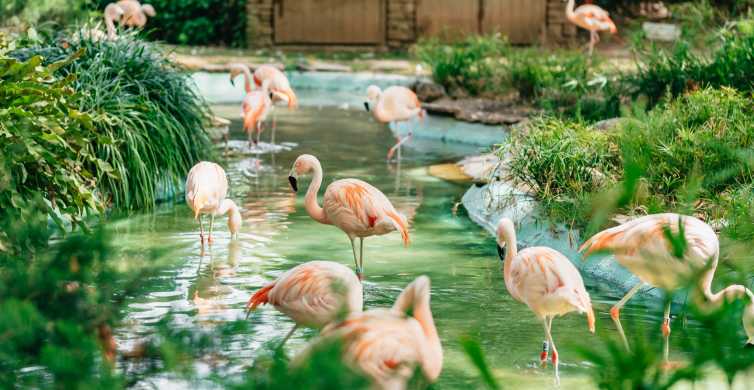
Still here: gorillas — the zoo keeps the bloodline that made Snowflake world-famous — plus lions, giraffes, flamingos, crocodiles, one of Europe's largest reptile and amphibian collections and around 70 bird species. The Land of Dragons area gathers Asian and Pacific species including Komodo dragons and muntjac deer, and the farm and children's playgrounds are running as normal.
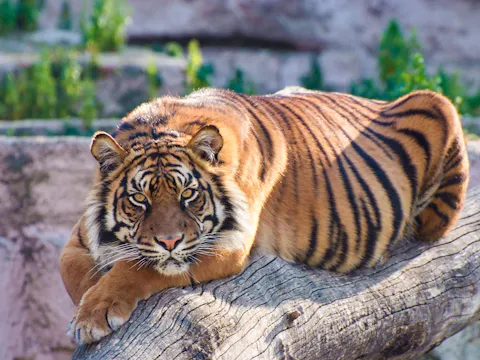
On the way out: the new model does without tigers, elephants, penguins and kangaroos. The last two Sumatran tigers, Tibor and Pertama, died in July and October 2025 of age-related problems, and Yoyo — the oldest African elephant known in captivity — died in December 2024. The remaining elephants live in an enlarged enclosure of some 6,000 m² designed for old age, with no replacements coming.
What's coming: three new spaces. Descobrim la Mediterrània recreates ecosystems from coast to mountain and opens in phases from 2026; Aïllats focuses on island ecosystems with lemurs, tortoises, reptiles and amphibians; and the Bioscope, planned for around 2030, will fill more than 7,000 m² (3,000 of them indoors) telling the story of the origin of life, from water to land.
With kids: the real logistics
- Time: 3–4 hours is the honest figure. Thirteen hectares is a lot of small legs; the two-hour dash is possible, but you'll write off half the collection.
- Prams: the site is flat and fully walkable with a pushchair. Wheelchairs are lent free at the Ciutadella entrance, and there are free lockers for the bulky bag.
- Eating: two picnic areas with recycling bins — bringing sandwiches is the efficient move — plus the La Dama restaurant (opens 10:30, closes half an hour before the gates) and the El Xaloc cafeteria in the Sahel area, weekends and public holidays only.
- Babies: a breastfeeding room with changing table and microwave, changing facilities around the site, and a first-aid point beside the aviary.
- Breaks: there are playgrounds in the play zone and at the farm. Use them mid-visit: half an hour on a slide buys more goodwill than dragging a five-year-old past two more enclosures.
- Heat: in July and August the zoo turns punishing after midday and many animals go and hide. Be in at 10:00, out by 13:30, and save the afternoon for the beach or a nap.
Getting there and what to combine
Metro: the obvious stop is Ciutadella | Vila Olímpica (L4), right by the Wellington gate. Watch out: it is one of the handful of stations on the network that still has no lift. With a pram, a wheelchair or tired knees, get off at Arc de Triomf (L1), which is step-free, and walk the length of Ciutadella park — about ten minutes down the central promenade with the brick arch behind you. Barceloneta (L4) is the third option. Every TMB bus is low-floor with a ramp, so when in doubt, take the bus.
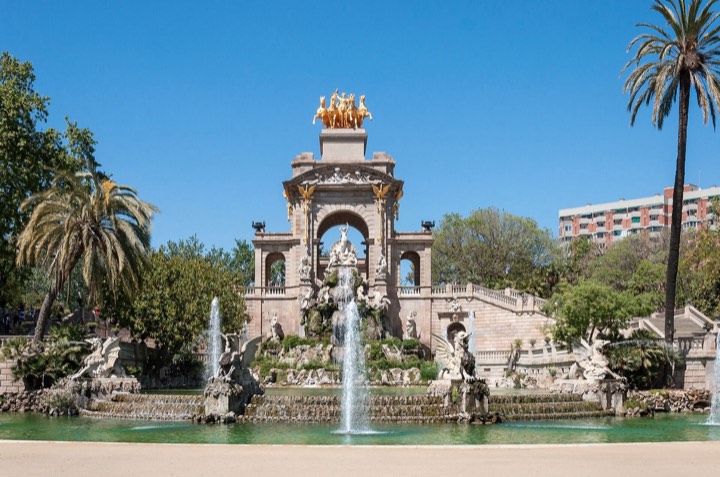
The park is part of the day. The zoo occupies one corner of Parc de la Ciutadella, the old town's green lung: the rowing-boat lake, the concrete mammoth and the monumental Cascada designed by Josep Fontserè — with a very young Antoni Gaudí helping as a student — are five minutes from the exit and free. Zoo in the morning, park in the afternoon is the cheapest and least stressful family day in Barcelona.
Nearby: El Born and the old town start on the far side of Passeig Picasso, with the Chocolate Museum and the Born market a short walk away; and Barceloneta beach is under twenty minutes on foot from the Wellington gate.
From 1892 to today: why the zoo is where it is
Barcelona Zoo opened in 1892 on ground just vacated by the 1888 Universal Exposition, in a park that itself sat on the site of the Bourbon citadel demolished in 1869. The first animals came from the private collection of Lluís Martí i Codolar, who kept them on his estate in Horta. So the zoo has spent 134 years in a space designed for something else, and that fit — 13 hectares in the middle of the city, with nowhere to expand — explains most of its recent history.
From 1966 to 2003 it housed the most famous animal in Spain: Snowflake (Floquet de Neu in Catalan, Copito de Nieve in Spanish), the only albino gorilla ever recorded. He fathered 21 offspring with three females and not one was born white; the albinism never passed on. His face is still on posters, souvenirs and in the memory of two generations of locals.
The uncomfortable part, stated plainly
Modern European zoos justify themselves through conservation: breeding programmes for endangered species, research and environmental education. Barcelona has been criticised for years by animal-protection groups — over the dolphinarium, over enclosure sizes, over keeping large mammals in a boxed-in urban site — and the 2019 plan is, to a large extent, the institution's answer to that pressure. Those same groups qualify their welcome: they applaud the end of confinement for certain species but say a deeper rethink of the zoo model itself is missing. Part of the workforce, meanwhile, has protested against the breeding restrictions.
We're not going to tell you whether to go in. The facts are these: it is an old urban zoo, under construction, shedding species and enlarging enclosures, with a genuine share of its budget going to conservation and research, and with well-founded criticism still open. With older children, the conversation about why the tigers and elephants are disappearing is probably the most valuable thing you'll take home.
Alternatives if the zoo isn't for you
- Barcelona Aquarium. Indoors, two hours, the best plan B in rain or 35-degree heat. An 80-metre underwater tunnel and an interactive floor built for small children.
- CosmoCaixa. The science museum, with its flooded Amazon forest under glass and an experiment room for under-8s. Free for under-16s and ideal for a wet morning.
- Tibidabo Amusement Park. Century-old rides on the ridge above the city, with the best views in Barcelona. Go up by FGC train and bus 196 to the Cuca de Llum funicular (the historic Tramvia Blau remains out of service) — the funicular ride is half the attraction.
- Ciutadella park itself. Free, with rowing boats, genuine shade and a concrete mammoth that has been the city's best unofficial climbing frame for decades.
- Our Barcelona with kids guide. The full plan by age group, with hours, prices and what to avoid in July and August.
Frequently asked questions
How much are Barcelona Zoo tickets?
Per the official website (zoobarcelona.cat, August 2026): €23 for adults, €13.90 for ages 3–12, free under 3, €11.20 from 65 and €6 with accredited disability. Large families and single-parent families get 20% off on presentation of the card.
Is there still a dolphin show at Barcelona Zoo?
No. Barcelona stopped programming dolphin performances in 2015 and moved its last three cetaceans to the Attica Zoological Park in Athens in 2020; the old Aquarama was demolished afterwards. Some tourism products still carry the old "with dolphin show" title, but what you buy today is a plain day ticket with no cetacean show.
What are Barcelona Zoo's opening hours?
It opens at 10:00 every day of the year. Closing time shifts with the season: 20:00 at the height of summer and considerably earlier in winter, around 16:30–17:30. The ticket office shuts an hour before the gates. Check the day's hours on zoobarcelona.cat.
How long do you need at Barcelona Zoo?
Three to four hours to cover the 13 hectares at a comfortable pace with stops to eat and play. Two hours gets you about half of it in a rush; with small children, block out the whole morning.
Which animals can you see at Barcelona Zoo now?
Gorillas, lions, giraffes, flamingos, crocodiles, one of Europe's largest reptile and amphibian collections and around 70 bird species. The zoo has given up tigers — the last two died in 2025 — and elephants, penguins and kangaroos are all set to disappear from the plan as the rebuild advances.
How do I get to Barcelona Zoo with a pram?
The nearest stop is Ciutadella | Vila Olímpica (L4), but it is one of the few stations that still has no lift. With a pram or wheelchair, get off at Arc de Triomf (L1), which is step-free, and walk across Ciutadella park to the gate; Barceloneta (L4) also works. Every TMB bus is low-floor with a ramp.
Can you eat inside the zoo or bring a picnic?
Both. There are two picnic areas with recycling bins, the La Dama restaurant (opens at 10:30 and closes half an hour before the zoo) and the El Xaloc cafeteria in the Sahel area, open weekends and public holidays, per zoobarcelona.cat.
Zoo or Aquarium — which is better?
It depends on the weather and the ages. The zoo is outdoors, has room to run and takes 3–4 hours: it wins on a fine day with children who need to move. The Aquarium is a two-hour indoor route and the better call in rain or extreme heat. If the ethics of animals in captivity weigh on you, Ciutadella park and CosmoCaixa are alternatives without that conflict.
Book your zoo ticket
One day ticket, no assigned time slot and no animal performances. Buying online saves you the ticket-office queue, and most options come with free cancellation.
See dates and prices