Barcelona: Sagrada Familia Entry Ticket with Audio Guide
4.6 (121,104 reviews)
from €33.80Check dates
February has no public holidays, a real street festival and January's prices — see the month's numbers
February wins by elimination. It keeps January's floor-level prices and empty landmarks, but without a single public holiday to shut the city down, with more than an extra hour of daylight by the time the month ends, and with two proper festivals: Santa Eulàlia and — usually — Carnival. And the congress that sends hotel rates through the roof, Mobile World Congress, lands in March, not here.
ⓘ Note: this is not the official website This is not the official website of any weather service or of the attractions mentioned. We are an independent guide: the climate figures are long-term averages (not a forecast) and opening hours come from each landmark's official site. Bookings are processed by authorised partners such as GetYourGuide.24 options · Prices checked on 18 October 2026
No options match these filters.
4.6 (121,104 reviews)
from €33.80Check dates
4.8 (15,271 reviews)
from €73.80Check dates
4.6 (9,388 reviews)
from €52.80Check dates
4.7 (7,100 reviews)
from €39Check dates
4.8 (5,535 reviews)
from €52.80Check dates
4.7 (5,268 reviews)
from €35Check dates
4.7 (8,286 reviews)
from €10.25Check dates
4.8 (4,382 reviews)
from €59.25Check dates
4.9 (3,170 reviews)
from €85Check dates
| Figure | February | Context |
|---|---|---|
| Average high | 15 °C | A degree above January; the late-month afternoons show it |
| Average low | 6 °C | Same as January — the nights are still winter |
| Sea temperature | 13 °C | Annual low with January; the water lags the air by weeks |
| Rain days | ~4 | One of the driest months of the year, level with January |
| Daylight | ~10 h → ~11 h 15 min | Dark just after 18:00 on the 1st, around 18:35 by the 28th |
| Crowds | Low | Only rises over the Santa Eulàlia and Carnival weekends |
| Price level | Lowest of the year | Level with January, and with no holiday weekend to break it |
Temperatures, sea and rain days: 1991-2020 reference-period climate averages compiled by climatestotravel.com from AEMET data, rounded, and identical to those in our month-by-month table. Daylight is an approximate astronomical calculation for Barcelona's latitude (41.4° N). These are historical means, not a forecast — check aemet.es or meteo.cat in the days before you travel.
On paper February is January plus one degree. In practice it is a good deal better, and the reason is the clock rather than the thermometer. It gets dark just after 18:00 on 1 February and close to 18:35 on the 28th. That reclaimed hour changes the shape of the day: it gives you a genuine late afternoon after the last museum, lets you finish at a viewpoint, and stops the city feeling like it shuts mid-afternoon the way it does in December.
The typical daily range is 8 to 16 °C. The first fortnight is still proper winter; in the second half it is normal for a sunny afternoon to reach 18 or 19 °C and for the terraces in El Born and Gràcia to fill as though March had arrived early. It's a daily illusion, though — the moment the sun drops you're back in the jacket, and nights still average 6 °C. As in January, the problem is rarely the street but the indoors: many older buildings and holiday flats have no central heating. Check before you book, don't assume.
The sea lags the air and sits at its annual floor of 13 °C. Swimming is out; walking the beaches on a sunny Sunday is very much in. One calendar fact that surprises visitors: February has no public holidays at all in Barcelona. Everything runs normal hours for all 28 days (29 in leap years such as 2028).
This is the month with the most street festivity of the whole winter — and nearly all of it is free.
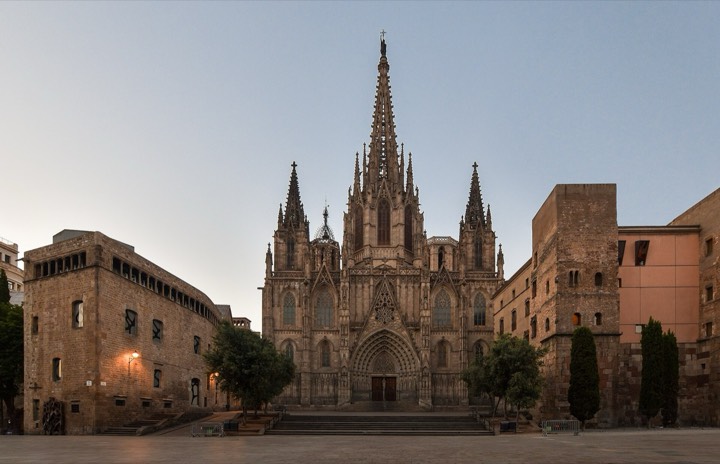
February's practical advantage over January is that you can string together two big visits and still have light left. A realistic day: a landmark at 9:00, a long lunch, a museum mid-afternoon, and a viewpoint at sunset without rushing.
February shares January's floor on flights and hotels, but spreads it better: January concentrates its expensive rates between the 1st and the 6th, whereas February has no holiday weekend at all to break the curve. All 28 days are cheap.
The decisive comparison, though, isn't with January — it's with March. Mobile World Congress runs 1-4 March 2027 at Fira Gran Via, and for that week Barcelona becomes one of the most expensive cities in Europe: more than a hundred thousand attendees empty the hotel stock and rates climb past even August levels. That spike does not touch February. It is the practical reason why, if you're choosing between late February and early March, February wins clearly — and why it's worth checking your dates don't brush the run-up days, when rates already begin to move.
| February | March | August | |
|---|---|---|---|
| Avg high / low | 15 / 6 °C | 17 / 8 °C | 29 / 21 °C |
| Sea | 13 °C | 13 °C | 25 °C |
| Rain days | ~4 | ~5 | ~5 |
| Crowds | Low | Medium | Peak |
| Hotel prices | Annual low | Extreme spike during MWC (1-4 March 2027) | Very high all month |
| Sagrada Família lead time | 1-2 days | ~1 week | 3-4 weeks |
Climate data: the same 1991-2020 averages used in our month-by-month table. MWC 2027 dates as published by the congress organisers. Crowd levels, prices and lead times are our own estimates, based on the city's tourism seasonality and on observed availability.
The other missing ingredient in February is the cruise season, still at its annual minimum. With no cruise calls, no congresses and no southern-European school holidays, the midday pile-ups on La Rambla and in the Gothic Quarter simply don't happen.
Like January, February is a decide-as-you-go month. These are the exceptions worth having on your list.
For a city trip it is probably the best value of the year. It shares January's rock-bottom prices and empty landmarks, but adds three things: no public holidays to shut the shops, noticeably longer days (dark after 18:30 by month's end), and Santa Eulàlia, the winter patron festival, with open-door days at several museums. What you won't get is the beach or long afternoons on a terrace.
Averages are 15 °C by day and 6 °C overnight — one degree warmer than January in daylight and effectively identical at night. A normal day runs between about 8 and 16 °C, and in the last weeks of the month a sunny afternoon can easily touch 18-19 °C. It is still a layers month: mornings and evenings are cold and the coastal humidity gets into everything.
To walk, yes; to swim, no. The sea is still around 13 °C, its annual low alongside January, and it doesn't pass 20 °C until June. That said, a sunny February Sunday along the Barceloneta promenade — beach bars open, not a towel in sight — is one of the most enjoyable things you can do in a Barcelona winter.
It is a movable date tied to Easter, so some years it falls in February and others in early March. It runs from Dijous Gras (Fat Thursday) to Ash Wednesday, which closes with the Burial of the Sardine. In 2027, Dijous Gras is 4 February and Ash Wednesday 10 February, so the whole of Carnival lands inside the month. Each district stages its own parade, or rua; programmes go up on barcelona.cat a few weeks beforehand.
Eulàlia is Barcelona's co-patron saint — she is buried in the crypt of the cathedral, which carries her name — and her feast day on 12 February anchors the city's winter patron festival: several days of giants, big-heads, castellers human towers, fire beasts and a huge free programme for children. Many municipal museums traditionally hold open-door days around then. Exactly which museums, and in which time slots, changes every year: check barcelona.cat shortly before you travel.
No. MWC takes place in early March: 1-4 March in 2027, at Fira Gran Via. That is good news if you travel in February, because the congress is what pushes Barcelona hotel rates above even August levels, and that spike does not touch February. If your dates fall at the very end of the month, just check they don't overlap the run-up days, when rates already start climbing.
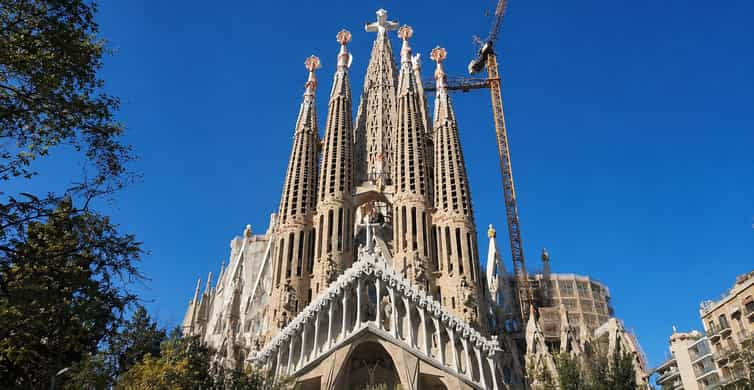
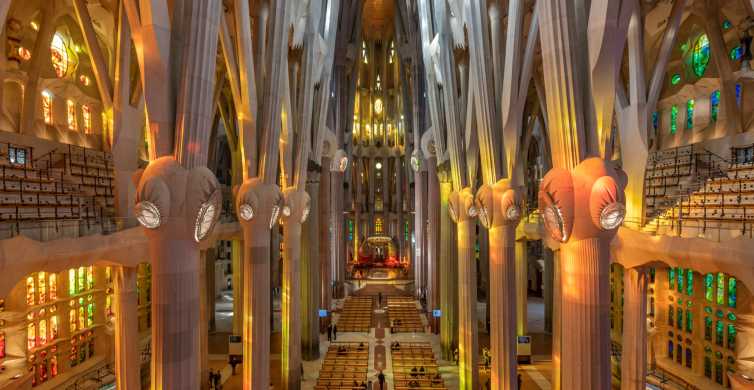
One or two days is almost always enough, against 3-4 weeks in July. You do still have to buy in advance, though: the Sagrada Família sells online only with a timed slot and there is no ticket office. In February it closes at 18:00, within its November-to-February hours according to its official website (sagradafamilia.org), so schedule the visit for the morning. Tower access is the one thing worth looking at earlier.
Prices and crowd levels are almost identical, and the climate differs by a single degree. The difference is the calendar and the light. January has two major holidays at the start (the 1st and the 6th) that close the shops and cut opening hours, plus an expensive first week; February has no holidays at all and runs at normal speed from start to finish. February also gains more than an hour of daylight over the month, and brings Santa Eulàlia and, usually, Carnival.
Floor-level prices, zero public holidays and landmarks with slots for tomorrow. Check your dates and lock in the few things that fill: the Santa Eulàlia weekend, Carnival, and the Sagrada Família towers. Free cancellation on most options.
See dates and prices